
Ch.6 - Ionic Compounds: Periodic Trends and Bonding Theory
McMurry - Chemistry 8th Edition
McMurry8th EditionChemistryISBN: 9781292336145Non è quello che usi tu?Cambia libro di testo
Capitolo 6, Problema 81

Cesium has the smallest ionization energy of all elements (376 kJ/mol), and chlorine has the most negative electron affinity 1-349 kJ/mol2. Will a cesium atom transfer an electron to a chlorine atom to form isolated Cs+1g2 and Cl-1g2 ions? Explain.

Guida verificata passo dopo passo
1
Identify the properties of cesium and chlorine relevant to the problem: Cesium has the lowest ionization energy among all elements, which means it requires the least amount of energy to remove an electron. Chlorine has a highly negative electron affinity, indicating it releases a significant amount of energy when it gains an electron.
Understand the process of electron transfer: Ionization energy is the energy required to remove an electron from an atom, forming a cation. Electron affinity is the energy released when an atom gains an electron, forming an anion.
Analyze the likelihood of electron transfer: Since cesium has a low ionization energy, it can easily lose an electron. Chlorine, with its high electron affinity, is very likely to accept an electron.
Predict the formation of ions: When cesium loses an electron, it forms a Cs+ ion. When chlorine gains an electron, it forms a Cl- ion.
Conclude the interaction: Due to cesium's propensity to lose an electron and chlorine's tendency to gain one, a cesium atom will likely transfer an electron to a chlorine atom, resulting in the formation of Cs+ and Cl- ions.

Risposta video verificata per un problema simile:

Questa soluzione video è stata consigliata dai nostri tutor come utile per risolvere questo problema.
Durata del video:
2m

Concetti chiave

Ecco i concetti essenziali che devi comprendere per rispondere correttamente alla domanda.

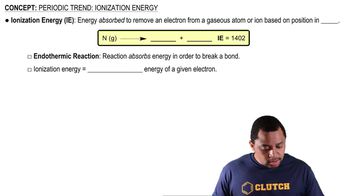
Ionization Energy

Ionization energy is the energy required to remove an electron from an atom in its gaseous state. Cesium, with the smallest ionization energy, means it can easily lose an electron, forming a Cs+ ion. This property is crucial in understanding the reactivity of cesium, particularly in its ability to participate in ionic bonding.
Video consigliato:
Percorso guidato
01:19
Ionization Energy

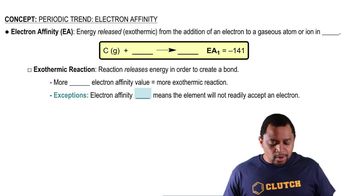
Electron Affinity

Electron affinity refers to the energy change that occurs when an electron is added to a neutral atom in the gas phase. Chlorine has a highly negative electron affinity, indicating that it releases a significant amount of energy when it gains an electron to form a Cl- ion. This strong tendency to gain an electron makes chlorine a powerful oxidizing agent.
Video consigliato:
Percorso guidato
01:34
Electron Affinity

Ionic Bond Formation

Ionic bond formation occurs when one atom transfers an electron to another, resulting in the creation of positively and negatively charged ions. In this case, cesium can easily lose an electron due to its low ionization energy, while chlorine can readily accept an electron due to its high electron affinity, leading to the formation of Cs+ and Cl- ions, which are stable in an ionic compound.
Video consigliato:
Percorso guidato
01:41
Amide Formation