
Ch.6 - Ionic Compounds: Periodic Trends and Bonding Theory
McMurry - Chemistry 8th Edition
McMurry8th EditionChemistryISBN: 9781292336145Non è quello che usi tu?Cambia libro di testo
Capitolo 6, Problema 3

Identify the false statement about atomic and ionic radii. (LO 6.3) (a) I- has a larger radius than Br- (b) Ba2+ has a smaller radius than Ba (c) Te has a larger radius than Te2- (d) Sr2+ has a smaller radius than Se2-

Guida verificata passo dopo passo
1
Step 1: Understand the concept of atomic and ionic radii. Atomic radius refers to the size of a neutral atom, while ionic radius refers to the size of an ion. When an atom gains electrons to form an anion, its radius typically increases due to increased electron-electron repulsion. Conversely, when an atom loses electrons to form a cation, its radius typically decreases due to reduced electron-electron repulsion.
Step 2: Analyze statement (a): I- has a larger radius than Br-. Compare the ionic radii of I- and Br-. Both are anions, and I- is located below Br- in the periodic table, which generally means it has a larger radius due to the addition of an electron shell.
Step 3: Analyze statement (b): Ba2+ has a smaller radius than Ba. Compare the ionic radius of Ba2+ with the atomic radius of Ba. Ba2+ is a cation formed by losing two electrons, which typically results in a smaller radius compared to the neutral atom.
Step 4: Analyze statement (c): Te has a larger radius than Te2-. Compare the atomic radius of Te with the ionic radius of Te2-. Te2- is an anion formed by gaining two electrons, which typically results in a larger radius compared to the neutral atom. This statement seems incorrect based on the general trend.
Step 5: Analyze statement (d): Sr2+ has a smaller radius than Se2-. Compare the ionic radius of Sr2+ with the ionic radius of Se2-. Sr2+ is a cation, and Se2- is an anion. Generally, cations have smaller radii than anions, especially when comparing ions from different groups.

Concetti chiave

Ecco i concetti essenziali che devi comprendere per rispondere correttamente alla domanda.

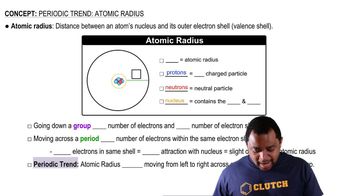
Atomic Radius

The atomic radius is a measure of the size of an atom, typically defined as the distance from the nucleus to the outermost electron shell. Atomic radii generally increase down a group in the periodic table due to the addition of electron shells, while they decrease across a period due to increased nuclear charge, which pulls electrons closer to the nucleus.
Video consigliato:

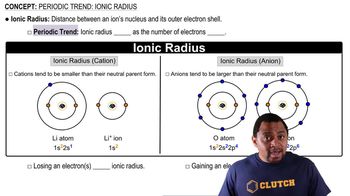
Ionic Radius

The ionic radius refers to the size of an ion in a crystal lattice. Cations (positively charged ions) are smaller than their neutral atoms because they lose electrons, resulting in reduced electron-electron repulsion and a stronger pull from the nucleus. Conversely, anions (negatively charged ions) are larger than their neutral atoms due to the addition of electrons, which increases repulsion among electrons.
Video consigliato:

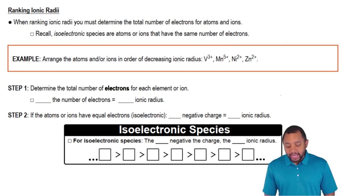
Trends in Ionic and Atomic Radii

Understanding the trends in ionic and atomic radii is crucial for comparing different elements and their ions. Generally, as you move down a group, both atomic and ionic radii increase, while moving across a period results in a decrease in atomic radius and a more complex pattern for ionic radii, influenced by the charge of the ions. This knowledge helps in evaluating statements about the relative sizes of different ions and atoms.
Video consigliato:
Percorso guidato
03:56
Ranking Ionic Radii