Ch.6 - Ionic Compounds: Periodic Trends and Bonding Theory
McMurry - Chemistry 8th Edition
McMurry8th EditionChemistryISBN: 9781292336145Non è quello che usi tu?Cambia libro di testo
Capitolo 6, Problema 104b

Iron is commonly found as Fe, Fe2+, and Fe3+. (b) What are the n and l quantum numbers of the electron removed on going from Fe2+ to Fe3+?

Guida verificata passo dopo passo
1
Determine the electron configuration of Fe^{2+}.
Identify the electron configuration of Fe^{3+}.
Compare the electron configurations of Fe^{2+} and Fe^{3+} to find the electron that is removed.
Identify the quantum numbers n and l for the removed electron.
Conclude with the n and l values for the electron removed from Fe^{2+} to form Fe^{3+}.

Risposta video verificata per un problema simile:

Questa soluzione video è stata consigliata dai nostri tutor come utile per risolvere questo problema.
Durata del video:
5m

Concetti chiave

Ecco i concetti essenziali che devi comprendere per rispondere correttamente alla domanda.

Quantum Numbers

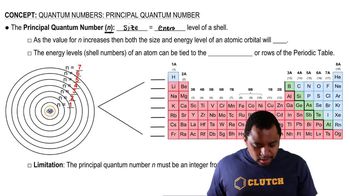
Quantum numbers are numerical values that describe the unique quantum state of an electron in an atom. The four quantum numbers include the principal quantum number (n), which indicates the energy level, and the azimuthal quantum number (l), which describes the shape of the orbital. Understanding these numbers is essential for determining the electron configuration and the specific electron being removed during ionization.
Video consigliato:
Percorso guidato
02:55
Principal Quantum Number

Electron Configuration

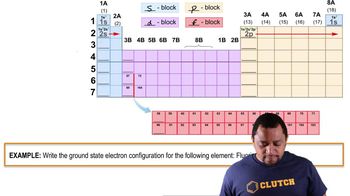
Electron configuration refers to the distribution of electrons in an atom's orbitals. For iron (Fe), the electron configuration is [Ar] 4s² 3d⁶. When iron loses electrons to form ions, the electrons are removed from the outermost energy levels first, which is crucial for identifying which electron is lost when transitioning from Fe²⁺ to Fe³⁺.
Video consigliato:
Percorso guidato
01:33
Electron Configuration Example

Ionization

Ionization is the process of removing one or more electrons from an atom or ion, resulting in a positively charged ion. In the case of Fe²⁺ to Fe³⁺, one electron is removed from the 3d subshell. Understanding the ionization process helps in determining the specific quantum numbers of the electron that is lost during the transition between these two oxidation states.
Video consigliato:
Percorso guidato
02:22
Auto-Ionization and Kw
Pratica correlata
Domanda del libro di testo
Take a guess. What do you think is a likely ground-state electron configuration for the sodium ion, Na+, formed by loss of an electron from a neutral sodium atom?
601
views

Domanda del libro di testo
Consider the electronic structure of the element bismuth. (d) Would you expect element 115 to have an ionization ene-rgy greater than, equal to, or less than that of bismuth? Explain.
445
views
Domanda del libro di testo
The ionization energy of an atom can be measured by photo-electron spectroscopy, in which light of wavelength l is directed at an atom, causing an electron to be ejected. The kinetic energy of the ejected electron 1EK2 is measured by determining its velocity, v since EK = 1/2 mv2. The Ei is then calculated using the relationship that the energy of the inci-dent light equals the sum of Ei plus EK. (a) What is the ionization energy of rubidium atoms in kilo-joules per mole if light with l = 58.4 nm produces elec-trons with a velocity of 2.450 * 106m/s? (The mass of an electron is 9.109 * 10-31 kg.)
2585
views
1
rank
1
comments
Domanda del libro di testo

Iron is commonly found as Fe, Fe2++, and Fe3+. (c) The third ionization energy of Fe is Ei3 = +2952 kJ/mol. What is the longest wavelength of light that could ionize Fe2+(g) to Fe3+(g)?

1646
views
Domanda del libro di testo

Consider the electronic structure of the element bismuth. (a) The first ionization energy of bismuth is Ei1 = +703 kJ/ mol. What is the longest possible wavelength of light that could ionize an atom of bismuth?

1042
views