Ch.6 - Ionic Compounds: Periodic Trends and Bonding Theory
McMurry - Chemistry 8th Edition
McMurry8th EditionChemistryISBN: 9781292336145Non è quello che usi tu?Cambia libro di testo
Capitolo 6, Problema 104c

Iron is commonly found as Fe, Fe2++, and Fe3+. (c) The third ionization energy of Fe is Ei3 = +2952 kJ/mol. What is the longest wavelength of light that could ionize Fe2+(g) to Fe3+(g)?

Guida verificata passo dopo passo
1
Identify the process: The problem involves the ionization of Fe^{2+} to Fe^{3+}, which requires the third ionization energy, E_{i3}.
Use the relationship between energy and wavelength: The energy of a photon is related to its wavelength by the equation E = \(\frac{hc}{\lambda}\), where E is the energy, h is Planck's constant (6.626 \(\times\) 10^{-34} \(\text{ J s}\)), c is the speed of light (3.00 \(\times\) 10^8 \(\text{ m/s}\)), and \(\lambda\) is the wavelength.
Convert the ionization energy from kJ/mol to J/photon: Since the ionization energy is given per mole, convert it to energy per photon by dividing by Avogadro's number (6.022 \(\times\) 10^{23} \(\text{ mol}\)^{-1}).
Rearrange the equation to solve for wavelength: \(\lambda\) = \(\frac{hc}{E}\). Substitute the values for h, c, and the energy per photon into this equation.
Calculate the wavelength: Perform the calculation to find the longest wavelength of light that can ionize Fe^{2+} to Fe^{3+}.

Risposta video verificata per un problema simile:

Questa soluzione video è stata consigliata dai nostri tutor come utile per risolvere questo problema.
Durata del video:
4m

Concetti chiave

Ecco i concetti essenziali che devi comprendere per rispondere correttamente alla domanda.

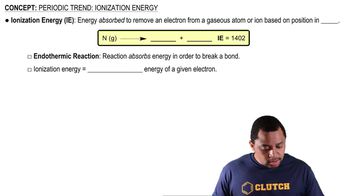
Ionization Energy

Ionization energy is the energy required to remove an electron from an atom or ion in the gas phase. For Fe<sup>2+</sup>, the ionization energy to form Fe<sup>3+</sup> is significant because it indicates how much energy is needed to overcome the attraction between the positively charged nucleus and the negatively charged electron. The third ionization energy of Fe, given as +2952 kJ/mol, provides a reference for understanding the energy required for this specific transition.
Video consigliato:
Percorso guidato
01:19
Ionization Energy

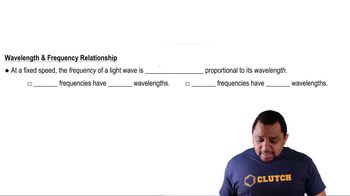
Photon Energy and Wavelength Relationship

The energy of a photon is inversely related to its wavelength, described by the equation E = hc/λ, where E is energy, h is Planck's constant, c is the speed of light, and λ is the wavelength. This relationship means that longer wavelengths correspond to lower energy photons. To find the longest wavelength capable of ionizing Fe<sup>2+</sup> to Fe<sup>3+</sup>, one must calculate the wavelength associated with the ionization energy of +2952 kJ/mol.
Video consigliato:
Percorso guidato
00:31
Frequency-Wavelength Relationship

Conversion of Energy Units

In chemistry, it is often necessary to convert energy units to work with different equations. Ionization energy is typically given in kJ/mol, while photon energy is expressed in joules. To use the ionization energy in the photon energy equation, one must convert kJ/mol to joules per photon by dividing the energy by Avogadro's number (6.022 x 10²³ mol<sup>-1</sup>). This conversion is crucial for accurately determining the corresponding wavelength of light.
Video consigliato:
Percorso guidato
01:56
Conversion Factors