Ch.6 - Ionic Compounds: Periodic Trends and Bonding Theory
McMurry - Chemistry 8th Edition
McMurry8th EditionChemistryISBN: 9781292336145Non è quello che usi tu?Cambia libro di testo
Capitolo 6, Problema 51

Order the following ions from smallest to largest: Mg2+, O2-, F-, Na+.

Guida verificata passo dopo passo
1
Identify the ions and their electron configurations: Mg^{2+}, O^{2-}, F^-, Na^+.
Recognize that all these ions are isoelectronic, meaning they have the same number of electrons.
Determine the electron configuration for each ion: all have the electron configuration of Ne, 1s^2 2s^2 2p^6.
Understand that the size of isoelectronic ions is determined by the nuclear charge: the more protons, the smaller the ion.
Order the ions based on increasing nuclear charge: O^{2-} (8 protons), F^- (9 protons), Na^+ (11 protons), Mg^{2+} (12 protons).

Risposta video verificata per un problema simile:

Questa soluzione video è stata consigliata dai nostri tutor come utile per risolvere questo problema.
Durata del video:
5m

Concetti chiave

Ecco i concetti essenziali che devi comprendere per rispondere correttamente alla domanda.

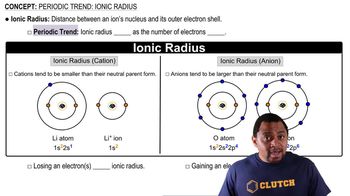
Ionic Radius

Ionic radius refers to the size of an ion in a crystal lattice. Cations, like Mg2+, are smaller than their neutral atoms due to the loss of electrons, which reduces electron-electron repulsion and allows the remaining electrons to be pulled closer to the nucleus. Conversely, anions, such as O2- and F-, are larger than their neutral counterparts because the addition of electrons increases repulsion among them, leading to a larger radius.
Video consigliato:

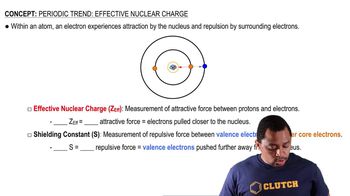
Effective Nuclear Charge

Effective nuclear charge (Z_eff) is the net positive charge experienced by an electron in a multi-electron atom. It accounts for the shielding effect of inner electrons that reduces the full nuclear charge. Ions with a higher Z_eff will generally have a smaller radius because the increased attraction between the nucleus and the electrons pulls them closer, resulting in a smaller ionic size.
Video consigliato:
Percorso guidato
01:51
Effective Nuclear Charge

Trends in Ionic Size

Ionic size trends can be observed in the periodic table, where cations decrease in size across a period due to increasing nuclear charge, while anions increase in size. Additionally, within a group, ionic size increases down the group due to the addition of electron shells. Understanding these trends is essential for comparing the sizes of different ions, such as Mg2+, O2-, F-, and Na+.
Video consigliato: