The following ions all have the same number of electrons: Ti4+, Sc3+, Ca2+, S2-. Order them according to their expected sizes, and explain your answer.
Guida verificata passo dopo passo
1
insert step 1> Identify the number of electrons in each ion. Since they all have the same number of electrons, determine the electron configuration for one of them.
insert step 2> Recognize that all these ions are isoelectronic, meaning they have the same electron configuration. For example, they all have the electron configuration of argon (Ar), which is 1s^2 2s^2 2p^6 3s^2 3p^6.
insert step 3> Understand that the size of isoelectronic ions is determined by the number of protons in the nucleus. More protons result in a greater effective nuclear charge, pulling the electrons closer and making the ion smaller.
insert step 4> List the ions in order of increasing atomic number (number of protons): S^2- (16 protons), Ca^2+ (20 protons), Sc^3+ (21 protons), Ti^4+ (22 protons).
insert step 5> Conclude that the order of increasing size is Ti^4+ < Sc^3+ < Ca^2+ < S^2-, because the ion with the fewest protons (S^2-) will be the largest, and the ion with the most protons (Ti^4+) will be the smallest.
Risposta video verificata per un problema simile:
Questa soluzione video è stata consigliata dai nostri tutor come utile per risolvere questo problema.
Durata del video:
2m
Guarda un video:
0 Commenti
Concetti chiave
Ecco i concetti essenziali che devi comprendere per rispondere correttamente alla domanda.
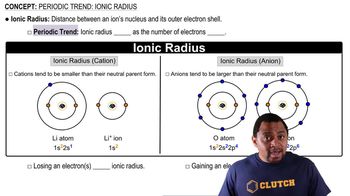
Ionic Radius
Ionic radius refers to the size of an ion in a crystal lattice. Cations (positively charged ions) are generally smaller than their neutral atoms due to the loss of electrons, which reduces electron-electron repulsion and allows the remaining electrons to be pulled closer to the nucleus. Conversely, anions (negatively charged ions) are larger than their neutral atoms because the addition of electrons increases repulsion among them, causing the electron cloud to expand.
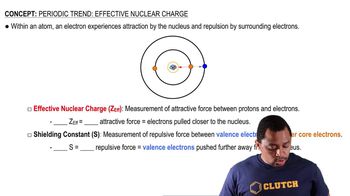
Effective nuclear charge is the net positive charge experienced by an electron in a multi-electron atom. It accounts for the shielding effect of inner-shell electrons that reduce the full nuclear charge felt by outer-shell electrons. A higher Z_eff leads to a stronger attraction between the nucleus and the electrons, resulting in a smaller ionic radius for cations, while a lower Z_eff in anions leads to a larger ionic radius.
An isoelectronic series consists of ions or atoms that have the same number of electrons but different nuclear charges. In the case of Ti4+, Sc3+, Ca2+, and S2-, all have 18 electrons, but their nuclear charges differ. The size of the ions in this series decreases with increasing nuclear charge, as the greater positive charge pulls the electron cloud closer to the nucleus, resulting in smaller ionic radii for cations compared to anions.