Ch.7 - Covalent Bonding and Electron-Dot Structures
McMurry - Chemistry 8th Edition
McMurry8th EditionChemistryISBN: 9781292336145Non è quello che usi tu?Cambia libro di testo
Capitolo 7, Problema 35

Characterize bonds between the two atoms as covalent or ionic. (a) Cl and F (b) Rb and F (c) Na and S (d) N and S

Guida verificata passo dopo passo
1
Step 1: Understand the difference between covalent and ionic bonds. Covalent bonds involve the sharing of electrons between atoms, typically nonmetals, while ionic bonds involve the transfer of electrons from one atom to another, typically between a metal and a nonmetal.
Step 2: Analyze the electronegativity difference between the two atoms in each pair. A large difference (usually greater than 1.7) suggests an ionic bond, while a smaller difference suggests a covalent bond.
Step 3: For each pair, identify whether the atoms are metals or nonmetals. Nonmetals tend to form covalent bonds with each other, while metals and nonmetals tend to form ionic bonds.
Step 4: Apply these principles to each pair: (a) Cl and F are both nonmetals, likely forming a covalent bond. (b) Rb is a metal and F is a nonmetal, likely forming an ionic bond. (c) Na is a metal and S is a nonmetal, likely forming an ionic bond. (d) N and S are both nonmetals, likely forming a covalent bond.
Step 5: Conclude by characterizing each bond based on the analysis: (a) covalent, (b) ionic, (c) ionic, (d) covalent.

Risposta video verificata per un problema simile:

Questa soluzione video è stata consigliata dai nostri tutor come utile per risolvere questo problema.

Concetti chiave

Ecco i concetti essenziali che devi comprendere per rispondere correttamente alla domanda.

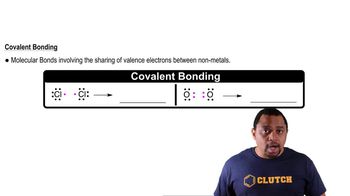
Covalent Bonds

Covalent bonds form when two atoms share one or more pairs of electrons, typically between nonmetals. This sharing allows each atom to attain a stable electron configuration, often resembling that of noble gases. For example, in a Cl-F bond, both chlorine and fluorine are nonmetals that share electrons, resulting in a covalent bond.
Video consigliato:

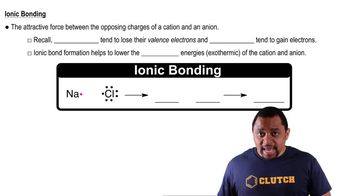
Ionic Bonds

Ionic bonds occur when one atom donates an electron to another, resulting in the formation of charged ions. This typically happens between metals and nonmetals, where the metal loses electrons and becomes positively charged, while the nonmetal gains electrons and becomes negatively charged. For instance, in the Rb-F bond, rubidium (a metal) donates an electron to fluorine (a nonmetal), creating an ionic bond.
Video consigliato:

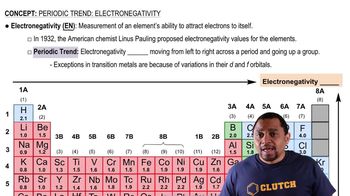
Electronegativity

Electronegativity is a measure of an atom's ability to attract and hold onto electrons in a bond. The difference in electronegativity between two atoms helps determine the type of bond formed: a large difference typically indicates an ionic bond, while a small difference suggests a covalent bond. For example, the electronegativity difference between Na and S indicates that they will form an ionic bond, while the difference between N and S suggests a covalent bond.
Video consigliato:
Percorso guidato
02:10
Electronegativity Trends
Pratica correlata
Domanda del libro di testo
Match the following descriptions with the type of bond (ionic, nonpolar covalent, covalent). (a) One or more electrons are transferred from a metal to a nonmetal atom.
923
views

Domanda del libro di testo

Electrostatic potential maps of acetaldehyde (C2H4), ethane (C2H6), ethanol (C2H6O), and fluorethane (C2H5F) are shown. Which do you think is which? (a)

(b)

(c)

(d)

465
views
Domanda del libro di testo
Why do two atoms come together to form a covalent bond? (a) Attractive forces between the positively charged nuclei and the electrons in both atoms occur when the atoms are close together. (b) Repulsive forces between protons in the nuclei of the two atoms are minimized when the atoms are close together. (c) Repulsive forces between electrons in the two atoms are minimized when the atoms are close together.
953
views
Domanda del libro di testo
The following ball-and-stick molecular model is a representation of thalidomide, a drug that causes birth defects when taken by expectant mothers but is valuable for its use against leprosy. The lines indicate only the connections between atoms, not whether the bonds are single, double, or triple. (Red = O, gray = C, blue = N, ivory = H). Give the formula of thalidomide, and indicate the positions of multiple bonds and lone pairs.

667
views
Domanda del libro di testo

Two electrostatic potential maps are shown, one of methyl-lithium (CH3Li) and the other of chloromethane (CH3Cl). Based on their polarity patterns, which do you think is which? (a)

(b)

498
views
Domanda del libro di testo
The following diagram shows the potential energy of two atoms as a function of internuclear distance. Which bond is the strongest? Which bond is the longest?

1175
views