Ch.7 - Covalent Bonding and Electron-Dot Structures
McMurry - Chemistry 8th Edition
McMurry8th EditionChemistryISBN: 9781292336145Non è quello che usi tu?Cambia libro di testo
Capitolo 7, Problema 40

Match the following descriptions with the type of bond (ionic, nonpolar covalent, covalent). (a) One or more electrons are transferred from a metal to a nonmetal atom.

Guida verificata passo dopo passo
1
Identify the key characteristics of the bond described in the problem.
Recognize that the transfer of electrons typically occurs between a metal and a nonmetal.
Recall that when electrons are transferred, the resulting bond is usually ionic.
Understand that ionic bonds form between atoms with significantly different electronegativities.
Match the description 'One or more electrons are transferred from a metal to a nonmetal atom' with the type of bond: ionic.

Risposta video verificata per un problema simile:

Questa soluzione video è stata consigliata dai nostri tutor come utile per risolvere questo problema.
Durata del video:
1m

Concetti chiave

Ecco i concetti essenziali che devi comprendere per rispondere correttamente alla domanda.

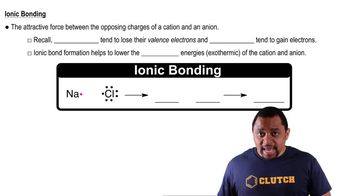
Ionic Bonding

Ionic bonding occurs when one atom donates one or more electrons to another atom, resulting in the formation of charged ions. Typically, this involves a metal atom losing electrons to become a positively charged cation, while a nonmetal atom gains those electrons to become a negatively charged anion. The electrostatic attraction between these oppositely charged ions creates a strong bond, characteristic of ionic compounds.
Video consigliato:

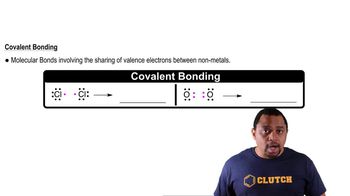
Covalent Bonding

Covalent bonding involves the sharing of electron pairs between atoms, usually between nonmetals. In this type of bond, atoms achieve stability by sharing electrons, which allows them to fill their outer electron shells. Covalent bonds can be single, double, or triple, depending on the number of shared electron pairs, and they can vary in polarity based on the electronegativity of the bonded atoms.
Video consigliato:

Nonpolar Covalent Bonding

Nonpolar covalent bonding occurs when two identical nonmetal atoms share electrons equally, resulting in no charge separation. This type of bond typically forms between atoms with similar electronegativities, such as in diatomic molecules like O2 or N2. Because the electron distribution is symmetrical, nonpolar covalent bonds do not create dipoles, making these molecules generally nonpolar in nature.
Video consigliato:
Pratica correlata
Domanda del libro di testo

What general trends in electronegativity occur in the periodic table?

657
views

Domanda del libro di testo

Electrostatic potential maps of acetaldehyde (C2H4), ethane (C2H6), ethanol (C2H6O), and fluorethane (C2H5F) are shown. Which do you think is which? (a)

(b)

(c)

(d)

465
views
Domanda del libro di testo
Why do two atoms come together to form a covalent bond? (a) Attractive forces between the positively charged nuclei and the electrons in both atoms occur when the atoms are close together. (b) Repulsive forces between protons in the nuclei of the two atoms are minimized when the atoms are close together. (c) Repulsive forces between electrons in the two atoms are minimized when the atoms are close together.
953
views
Domanda del libro di testo
Explain the difference in the bond dissociation energies for the following bonds: (C-F, 450 kJ/mol), (N-F, 270 kJ/mol), (O-F, 180 kJ/mol), (F-F, 159 kJ/mol).
1182
views
Domanda del libro di testo
The following ball-and-stick molecular model is a representation of thalidomide, a drug that causes birth defects when taken by expectant mothers but is valuable for its use against leprosy. The lines indicate only the connections between atoms, not whether the bonds are single, double, or triple. (Red = O, gray = C, blue = N, ivory = H). Give the formula of thalidomide, and indicate the positions of multiple bonds and lone pairs.

667
views
Domanda del libro di testo
Characterize bonds between the two atoms as covalent or ionic. (a) Cl and F (b) Rb and F (c) Na and S (d) N and S
523
views