Ch.7 - Covalent Bonding and Electron-Dot Structures
McMurry - Chemistry 8th Edition
McMurry8th EditionChemistryISBN: 9781292336145Non è quello che usi tu?Cambia libro di testo
Capitolo 7, Problema 42

Explain the difference in the bond dissociation energies for the following bonds: (C-F, 450 kJ/mol), (N-F, 270 kJ/mol), (O-F, 180 kJ/mol), (F-F, 159 kJ/mol).

Guida verificata passo dopo passo
1
Identify the bond dissociation energy (BDE) for each bond: C-F (450 kJ/mol), N-F (270 kJ/mol), O-F (180 kJ/mol), F-F (159 kJ/mol).
Understand that bond dissociation energy is the energy required to break a bond in a molecule, indicating bond strength.
Consider the electronegativity of the atoms involved: Fluorine is highly electronegative, affecting bond strength with different atoms.
Analyze the bond length: Shorter bonds are generally stronger, contributing to higher BDE.
Compare the atomic sizes and electronegativity differences: Larger differences in electronegativity and smaller atomic sizes typically result in stronger bonds, explaining the trend in BDE values.

Risposta video verificata per un problema simile:

Questa soluzione video è stata consigliata dai nostri tutor come utile per risolvere questo problema.
Durata del video:
2m

Concetti chiave

Ecco i concetti essenziali che devi comprendere per rispondere correttamente alla domanda.

Bond Dissociation Energy

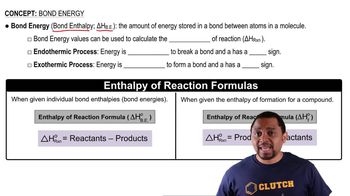
Bond dissociation energy (BDE) is the energy required to break a bond in a molecule, resulting in the formation of separate atoms. It is a measure of bond strength; higher BDE values indicate stronger bonds. BDE can vary significantly between different types of bonds due to factors such as atomic size, electronegativity, and the presence of lone pairs.
Video consigliato:

Electronegativity

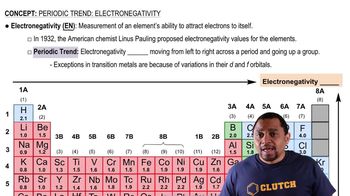
Electronegativity is the tendency of an atom to attract electrons in a chemical bond. In the context of the bonds mentioned, fluorine is highly electronegative, which affects the bond strength with other elements. The differences in electronegativity between the bonded atoms can lead to variations in bond character (ionic vs. covalent) and, consequently, the bond dissociation energies.
Video consigliato:
Percorso guidato
02:10
Electronegativity Trends

Atomic Size and Bond Length

Atomic size influences bond length, which in turn affects bond strength. Smaller atoms can form shorter, stronger bonds due to effective overlap of their atomic orbitals. In the case of the bonds listed, the size of the atoms involved (C, N, O, and F) contributes to the observed differences in bond dissociation energies, as shorter bonds generally have higher BDEs.
Video consigliato: