Identify the correct electron-dot structure for XeF 5+ (a) (b) (c)
Guida verificata passo dopo passo
1
Identify the total number of valence electrons in the XeF5+ molecule. Xenon (Xe) has 8 valence electrons and each fluorine (F) atom has 7 valence electrons. Since the molecule has a +1 charge, subtract one electron from the total count.
Arrange the electrons around the central atom (Xe) and the surrounding fluorine atoms. Start by placing a single bond (two electrons) between the xenon and each fluorine atom.
After bonding, place the remaining electrons around the fluorine atoms first to complete their octets (each fluorine should have 8 electrons around it including the shared electrons).
Check the electron count around the xenon atom. Xenon can have more than 8 electrons due to its ability to utilize d-orbitals for bonding (expanded octet).
Choose the structure where all atoms have complete octets (or expanded octet for xenon), and the total number of electrons matches the count from step 1. This structure should also reflect the molecular geometry and electron distribution that minimizes repulsion between electron pairs.
Risposta video verificata per un problema simile:
Questa soluzione video è stata consigliata dai nostri tutor come utile per risolvere questo problema.
Durata del video:
4m
Guarda un video:
0 Commenti
Concetti chiave
Ecco i concetti essenziali che devi comprendere per rispondere correttamente alla domanda.
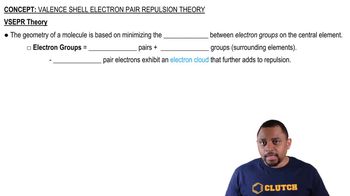
Valence Shell Electron Pair Repulsion (VSEPR) Theory
VSEPR theory is used to predict the geometry of molecules based on the repulsion between electron pairs in the valence shell of the central atom. It states that electron pairs will arrange themselves to minimize repulsion, leading to specific molecular shapes. For XeF5+, understanding the arrangement of five fluorine atoms around xenon is crucial for determining its geometry.
Electron-dot structures, or Lewis structures, represent the valence electrons of atoms within a molecule. They illustrate how electrons are shared or transferred between atoms, helping to visualize bonding and lone pairs. For XeF5+, drawing the correct Lewis structure involves placing the appropriate number of electrons around xenon and the fluorine atoms to reflect their bonding and charge.
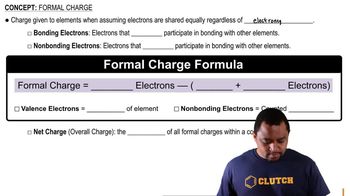
Formal charge is a concept used to determine the distribution of electrons in a molecule and assess the stability of a given structure. It is calculated by comparing the number of valence electrons in the free atom to the number of electrons assigned to it in the Lewis structure. For XeF5+, calculating formal charges helps identify the most stable electron-dot structure by ensuring that the total charge matches the molecular charge.