Ch.7 - Covalent Bonding and Electron-Dot Structures
McMurry - Chemistry 8th Edition
McMurry8th EditionChemistryISBN: 9781292336145Non è quello che usi tu?Cambia libro di testo
Capitolo 7, Problema 65

Which of the following substances contains an atom that does not follow the octet rule? (a) AlCl3 (b) PCl3 (c) PCl5 (d) SiCl4

Guida verificata passo dopo passo
1
Identify the central atom in each compound. For AlCl3, it's Al; for PCl3 and PCl5, it's P; for SiCl4, it's Si.
Determine the total number of valence electrons for the central atom in each compound. Aluminum has 3, Phosphorus has 5, and Silicon has 4 valence electrons.
Analyze the structure of each molecule to see how the valence electrons are distributed around the central atom. Remember that according to the octet rule, atoms tend to combine in such a way that they each have eight electrons in their valence shells.
Check if the central atom achieves an octet (8 electrons) through sharing electrons in covalent bonds. For example, in AlCl3, Al shares one electron with each of the three Cl atoms, totaling 6 electrons around Al.
Identify which compounds have central atoms that do not achieve an octet. In this case, Al in AlCl3 and P in PCl5 do not follow the octet rule, as Al ends up with 6 electrons and P in PCl5 ends up with 10 electrons.

Risposta video verificata per un problema simile:

Questa soluzione video è stata consigliata dai nostri tutor come utile per risolvere questo problema.
Durata del video:
2m

Concetti chiave

Ecco i concetti essenziali che devi comprendere per rispondere correttamente alla domanda.

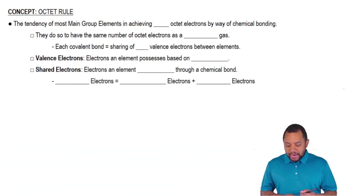
Octet Rule

The octet rule is a chemical guideline stating that atoms tend to bond in such a way that they each have eight electrons in their valence shell, achieving a stable electron configuration similar to that of noble gases. This rule primarily applies to main group elements and helps predict the bonding behavior of atoms in molecules.
Video consigliato:

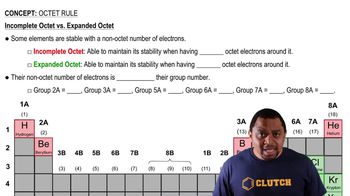
Expanded Octet

An expanded octet occurs when certain elements, particularly those in the third period and beyond, can accommodate more than eight electrons in their valence shell. This is possible due to the availability of d orbitals, allowing these atoms to form stable compounds with more than four bonds, as seen in molecules like PCl5.
Video consigliato:

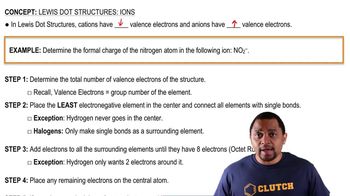
Lewis Structures

Lewis structures are diagrams that represent the bonding between atoms in a molecule and the lone pairs of electrons that may exist. They are essential for visualizing how atoms share or transfer electrons, helping to determine whether a molecule adheres to the octet rule or exhibits an expanded octet.
Video consigliato:
Percorso guidato
04:28
Lewis Dot Structures: Ions