Ch.7 - Covalent Bonding and Electron-Dot Structures
McMurry - Chemistry 8th Edition
McMurry8th EditionChemistryISBN: 9781292336145Non è quello che usi tu?Cambia libro di testo
Capitolo 7, Problema 3

The compounds below are paired with a type of bonding. Which type of bonding is incorrectly classified? (LO 7.5) (a) Rb2O (polar covalent) (b) SO2 (polar covalent) (c) O3 (nonpolar covalent) (d) KBr (ionic) (e) HF (polar covalent)

Guida verificata passo dopo passo
1
Identify the types of chemical bonds: ionic, polar covalent, and nonpolar covalent.
Recall that ionic bonds typically form between metals and nonmetals, where electrons are transferred.
Recall that covalent bonds form between nonmetals, where electrons are shared. Polar covalent bonds have unequal sharing, while nonpolar covalent bonds have equal sharing.
Examine each compound: (a) Rb2O, (b) SO2, (c) O3, (d) KBr, (e) HF, and determine the elements involved and their positions in the periodic table.
Compare the electronegativity differences for each pair of elements in the compounds to determine if the classification of the bond type is correct.

Risposta video verificata per un problema simile:

Questa soluzione video è stata consigliata dai nostri tutor come utile per risolvere questo problema.
Durata del video:
5m

Concetti chiave

Ecco i concetti essenziali che devi comprendere per rispondere correttamente alla domanda.

Types of Chemical Bonding

Chemical bonding primarily includes ionic, covalent, and metallic bonds. Ionic bonds occur between metals and nonmetals, involving the transfer of electrons, while covalent bonds involve the sharing of electrons between nonmetals. Understanding these types helps classify compounds based on their constituent elements and their electronegativity differences.
Video consigliato:

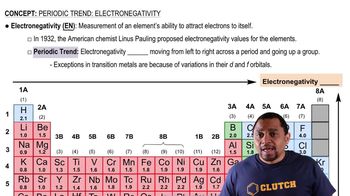
Electronegativity

Electronegativity is a measure of an atom's ability to attract and hold onto electrons in a bond. The difference in electronegativity between two atoms determines the type of bond formed: a large difference typically indicates ionic bonding, while a smaller difference suggests covalent bonding. This concept is crucial for predicting the polarity of molecules.
Video consigliato:
Percorso guidato
02:10
Electronegativity Trends

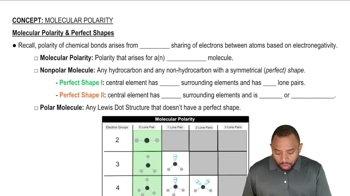
Polarity of Molecules

Polarity refers to the distribution of electrical charge over the atoms in a molecule. A molecule is polar if it has a significant difference in electronegativity between bonded atoms, leading to a dipole moment. Nonpolar molecules, on the other hand, have an even distribution of charge. Recognizing polarity is essential for understanding molecular interactions and properties.
Video consigliato:
Percorso guidato
02:38
Molecular Polarity