Ch.7 - Covalent Bonding and Electron-Dot Structures
McMurry - Chemistry 8th Edition
McMurry8th EditionChemistryISBN: 9781292336145Non è quello che usi tu?Cambia libro di testo
Capitolo 7, Problema 5

Which compound is a solid at room temperature? (LO 7.8) (a) H2O (b) Na2S (c) SO3 (d) Cl2

Guida verificata passo dopo passo
1
insert step 1> Identify the type of bonding and structure for each compound.
insert step 2> Consider the typical state of matter for each type of compound at room temperature.
insert step 3> Recognize that ionic compounds, like Na2S, are usually solids at room temperature due to strong ionic bonds.
insert step 4> Note that molecular compounds, like H2O, SO3, and Cl2, are often gases or liquids at room temperature, except for water which is a liquid.
insert step 5> Conclude that Na2S is the compound that is a solid at room temperature.

Risposta video verificata per un problema simile:

Questa soluzione video è stata consigliata dai nostri tutor come utile per risolvere questo problema.
Durata del video:
4m

Concetti chiave

Ecco i concetti essenziali che devi comprendere per rispondere correttamente alla domanda.

States of Matter

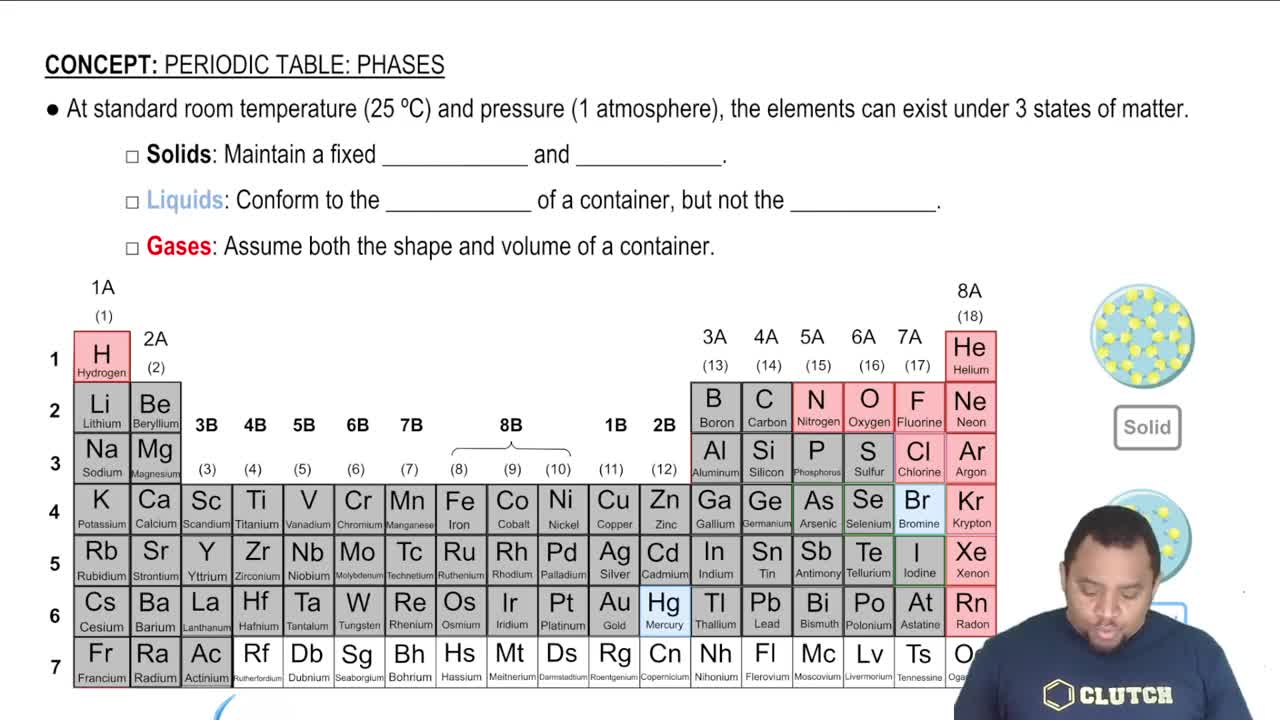
Matter exists in different states: solid, liquid, and gas, depending on temperature and pressure. At room temperature (approximately 20-25°C), substances can be classified based on their molecular structure and intermolecular forces. Solids have tightly packed particles that vibrate in place, while liquids have more space between particles, allowing them to flow.
Video consigliato:
Percorso guidato
03:25
Element States of Matter

Melting Point

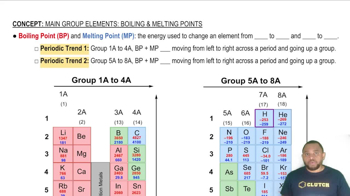
The melting point is the temperature at which a solid becomes a liquid. Compounds with high melting points tend to remain solid at room temperature. Understanding the melting points of various compounds helps in predicting their state at given temperatures, which is crucial for answering questions about their physical properties.
Video consigliato:
Percorso guidato
04:29
Boiling Point and Melting Point

Ionic vs. Molecular Compounds

Ionic compounds, such as Na2S, typically form solid structures at room temperature due to strong electrostatic forces between ions. In contrast, molecular compounds like H2O, SO3, and Cl2 may exist as liquids or gases at room temperature, depending on their molecular interactions. Recognizing the differences between these types of compounds aids in determining their physical states.
Video consigliato:
Percorso guidato
02:11
Ionic Compounds Naming