Ch.7 - Covalent Bonding and Electron-Dot Structures
McMurry - Chemistry 8th Edition
McMurry8th EditionChemistryISBN: 9781292336145Non è quello che usi tu?Cambia libro di testo
Capitolo 7, Problema 15

Use formal charge to select which resonance structure makes the largest contribution to the resonance hybrid. (LO 7.16) (a) Structure I (b) Structure II (c) Structure III (d) All structures are equivalent and make the same contri-bution to the resonance hybrid. (I)
(II)
(III)

Guida verificata passo dopo passo
1
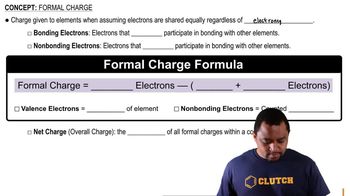
Identify the formal charge formula: \( \text{Formal Charge} = \text{Valence Electrons} - \text{Non-bonding Electrons} - \frac{1}{2} \times \text{Bonding Electrons} \).
Calculate the formal charge for each atom in Structure I using the formula.
Calculate the formal charge for each atom in Structure II using the formula.
Calculate the formal charge for each atom in Structure III using the formula.
Compare the formal charges of all structures: the structure with formal charges closest to zero and/or with negative charges on the more electronegative atoms will contribute most to the resonance hybrid.

Risposta video verificata per un problema simile:

Questa soluzione video è stata consigliata dai nostri tutor come utile per risolvere questo problema.
Durata del video:
11m

Concetti chiave

Ecco i concetti essenziali che devi comprendere per rispondere correttamente alla domanda.

Formal Charge

Formal charge is a theoretical charge assigned to an atom in a molecule, calculated by taking the number of valence electrons in the free atom, subtracting the number of non-bonding electrons, and half the number of bonding electrons. It helps in determining the most stable resonance structure, as structures with formal charges closer to zero are generally more favorable.
Video consigliato:

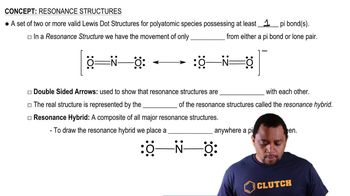
Resonance Structures

Resonance structures are different Lewis structures for the same molecule that depict the same arrangement of atoms but differ in the distribution of electrons. These structures are used to represent delocalized electrons in molecules, and the actual structure is a resonance hybrid, which is a weighted average of all valid resonance forms.
Video consigliato:
Percorso guidato
01:42
Resonance Structures

Resonance Hybrid

The resonance hybrid is the actual structure of a molecule that is a composite of all its resonance structures. It reflects the delocalization of electrons across the molecule, leading to increased stability. The contribution of each resonance structure to the hybrid depends on factors like formal charge, electronegativity, and overall stability.
Video consigliato: