
Ch.7 - Covalent Bonding and Electron-Dot Structures
McMurry - Chemistry 8th Edition
McMurry8th EditionChemistryISBN: 9781292336145Non è quello che usi tu?Cambia libro di testo
Capitolo 7, Problema 119

Use the data in Table 9.3 to calculate an approximate ∆H° in kilojoules for the synthesis of hydrazine from ammonia: 2 NH3(g) + Cl2(g) → N2H4(g) + 2 HCl(g)

Guida verificata passo dopo passo
1
Identify the bonds broken and formed in the reaction. For the reactants, you have N-H bonds in NH3 and a Cl-Cl bond in Cl2. For the products, you have N-N and N-H bonds in N2H4 and H-Cl bonds in HCl.
Use the bond enthalpy values from Table 9.3 to calculate the total energy required to break the bonds in the reactants. This involves multiplying the bond enthalpy by the number of each type of bond broken.
Calculate the total energy released by forming the bonds in the products. Again, use the bond enthalpy values and multiply by the number of each type of bond formed.
Determine the approximate ∆H° for the reaction by subtracting the total energy released (from bond formation) from the total energy required (for bond breaking).
Express the final ∆H° value in kilojoules, ensuring that you account for the stoichiometry of the reaction as given.

Risposta video verificata per un problema simile:

Questa soluzione video è stata consigliata dai nostri tutor come utile per risolvere questo problema.
Durata del video:
9m

Concetti chiave

Ecco i concetti essenziali che devi comprendere per rispondere correttamente alla domanda.

Enthalpy Change (∆H°)

Enthalpy change (∆H°) is the heat content change of a system at constant pressure during a chemical reaction. It indicates whether a reaction is exothermic (releases heat, ∆H° < 0) or endothermic (absorbs heat, ∆H° > 0). Calculating ∆H° for a reaction often involves using standard enthalpy values of formation for the reactants and products.
Video consigliato:
Percorso guidato
02:34
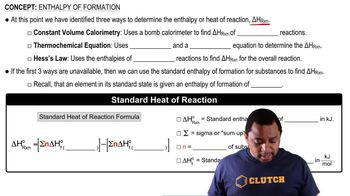
Enthalpy of Formation

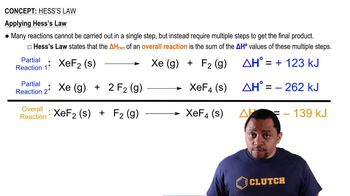
Hess's Law

Hess's Law states that the total enthalpy change for a reaction is the sum of the enthalpy changes for individual steps, regardless of the pathway taken. This principle allows for the calculation of ∆H° for a reaction by using known enthalpy changes of related reactions, facilitating the determination of enthalpy changes for complex reactions.
Video consigliato:

Standard Enthalpy of Formation

The standard enthalpy of formation (∆H°f) is the change in enthalpy when one mole of a compound is formed from its elements in their standard states. These values are tabulated for many substances and are essential for calculating the overall enthalpy change of a reaction using the formula: ∆H° = Σ(∆H°f products) - Σ(∆H°f reactants).
Video consigliato:
Percorso guidato
02:34
Enthalpy of Formation