

Ch.7 - Covalent Bonding and Electron-Dot Structures
McMurry - Chemistry 8th Edition
McMurry8th EditionChemistryISBN: 9781292336145Non è quello che usi tu?Cambia libro di testo
Capitolo 7, Problema 134

What is the difference between a covalent bond and an ionic bond?

Guida verificata passo dopo passo
1
Identify the types of elements involved: Covalent bonds typically form between nonmetals, while ionic bonds form between metals and nonmetals.
Understand electron sharing vs. transfer: In covalent bonds, atoms share electrons to achieve a full outer shell. In ionic bonds, electrons are transferred from one atom to another, creating ions.
Consider the resulting particles: Covalent bonding results in the formation of molecules, whereas ionic bonding results in the formation of a lattice structure composed of ions.
Examine the bond strength and properties: Covalent bonds are generally strong and can be polar or nonpolar, affecting the molecule's properties. Ionic bonds are also strong but can be broken in water, leading to high solubility and electrical conductivity in solution.
Look at examples: Water (H2O) is a common example of a covalent compound, while sodium chloride (NaCl) is a classic example of an ionic compound.

Risposta video verificata per un problema simile:

Questa soluzione video è stata consigliata dai nostri tutor come utile per risolvere questo problema.
Durata del video:
45s

Concetti chiave

Ecco i concetti essenziali che devi comprendere per rispondere correttamente alla domanda.

Covalent Bonding

Covalent bonding occurs when two atoms share one or more pairs of electrons, allowing each atom to attain a stable electron configuration. This type of bond typically forms between nonmetals, where the shared electrons enable both atoms to achieve full outer shells, resulting in a stable molecule. An example of a covalent bond is the bond between two hydrogen atoms in H2.
Video consigliato:

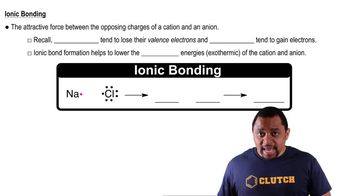
Ionic Bonding

Ionic bonding is the electrostatic attraction between positively charged ions (cations) and negatively charged ions (anions). This bond forms when one atom donates electrons to another, resulting in the formation of charged ions. A common example is sodium chloride (NaCl), where sodium donates an electron to chlorine, creating Na+ and Cl- ions that attract each other.
Video consigliato:

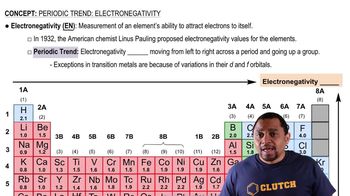
Electronegativity

Electronegativity is a measure of an atom's ability to attract and hold onto electrons in a chemical bond. In covalent bonds, atoms with similar electronegativities share electrons equally, while in ionic bonds, a significant difference in electronegativity leads to the complete transfer of electrons from one atom to another. Understanding electronegativity helps predict the type of bond that will form between two elements.
Video consigliato:
Percorso guidato
02:10
Electronegativity Trends