Ch.7 - Covalent Bonding and Electron-Dot Structures
McMurry - Chemistry 8th Edition
McMurry8th EditionChemistryISBN: 9781292336145Non è quello che usi tu?Cambia libro di testo
Capitolo 7, Problema 59a

Using only the elements Ca, Cl, and Si, give formulas for the following. (a) An ionic compound

Guida verificata passo dopo passo
1
Identify the charges of the ions formed by each element. Calcium (Ca) typically forms a +2 cation (Ca^2+). Chlorine (Cl) typically forms a -1 anion (Cl^-). Silicon (Si) can form a +4 cation (Si^4+), but it is less common in simple ionic compounds.
Choose the combination of cations and anions that will result in a neutral compound. Since we are forming an ionic compound, the total positive charge must balance the total negative charge.
For a simple ionic compound using Ca and Cl, combine Ca^2+ and Cl^- in a ratio that balances the charges. Since Ca^2+ has a +2 charge and Cl^- has a -1 charge, you will need two Cl^- ions to balance one Ca^2+ ion.
Write the formula for the compound by placing the cation first followed by the anion. Use subscripts to indicate the number of each ion needed to balance the charges.
The resulting formula for the ionic compound formed from calcium and chlorine is CaCl_2, which is calcium chloride.

Risposta video verificata per un problema simile:

Questa soluzione video è stata consigliata dai nostri tutor come utile per risolvere questo problema.
Durata del video:
49s

Concetti chiave

Ecco i concetti essenziali che devi comprendere per rispondere correttamente alla domanda.

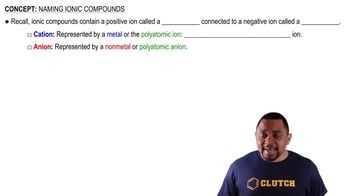
Ionic Compounds

Ionic compounds are formed when atoms transfer electrons, resulting in the formation of charged ions. Typically, a metal atom donates electrons to become a positively charged cation, while a non-metal atom accepts electrons to become a negatively charged anion. The electrostatic attraction between these oppositely charged ions leads to the formation of a stable ionic compound.
Video consigliato:
Percorso guidato
02:11
Ionic Compounds Naming

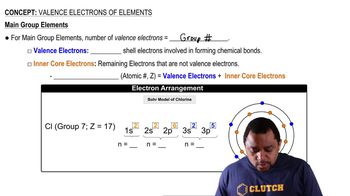
Valency of Elements

Valency refers to the ability of an atom to bond with other atoms, determined by the number of electrons in its outer shell. For example, calcium (Ca) has a valency of +2 as it can lose two electrons, chlorine (Cl) has a valency of -1 as it can gain one electron, and silicon (Si) typically has a valency of +4 or -4 depending on its bonding context. Understanding valency is crucial for predicting the formulas of compounds.
Video consigliato:
Percorso guidato
02:32
Main Group Elements Valence Electrons

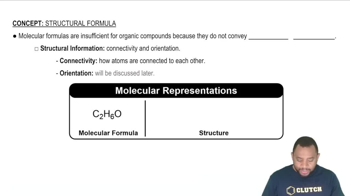
Chemical Formula Representation

A chemical formula represents the composition of a compound using symbols for the elements and numerical subscripts to indicate the number of atoms of each element. In ionic compounds, the formula reflects the ratio of cations to anions that results in a neutral charge. For example, in calcium chloride (CaCl2), one calcium ion pairs with two chloride ions to balance the overall charge.
Video consigliato:
Percorso guidato
02:08
Molecular Formula