Ch.7 - Covalent Bonding and Electron-Dot Structures
McMurry - Chemistry 8th Edition
McMurry8th EditionChemistryISBN: 9781292336145Non è quello che usi tu?Cambia libro di testo
Capitolo 7, Problema 56

Order the following compounds according to the increasing ionic character of their bonds: CCl4, BaCl2, TiCl3, ClO2.

Guida verificata passo dopo passo
1
Step 1: Understand the concept of ionic character. Ionic character refers to the degree to which a bond between two atoms has characteristics of an ionic bond, which typically involves the transfer of electrons from one atom to another.
Step 2: Identify the types of bonds in each compound. CCl4 and ClO2 have covalent bonds, while BaCl2 and TiCl3 have ionic bonds.
Step 3: Consider the electronegativity difference between the atoms in each compound. A larger difference in electronegativity usually indicates a greater ionic character.
Step 4: Compare the electronegativity differences. BaCl2, with a metal and a non-metal, is expected to have the highest ionic character. TiCl3, also a metal and non-metal compound, follows. CCl4 and ClO2, being covalent, have lower ionic character.
Step 5: Order the compounds from least to most ionic character: ClO2, CCl4, TiCl3, BaCl2.

Risposta video verificata per un problema simile:

Questa soluzione video è stata consigliata dai nostri tutor come utile per risolvere questo problema.
Durata del video:
4m

Concetti chiave

Ecco i concetti essenziali che devi comprendere per rispondere correttamente alla domanda.

Ionic Character

Ionic character refers to the degree to which a bond between two atoms exhibits ionic properties, which is influenced by the difference in electronegativity between the bonded atoms. A higher electronegativity difference typically results in a more ionic bond, while a smaller difference leads to a more covalent bond. Understanding this concept is crucial for comparing the ionic character of different compounds.
Video consigliato:
Percorso guidato
00:56
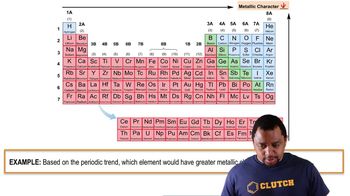
Metallic Character Example

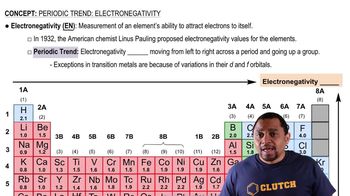
Electronegativity

Electronegativity is a measure of an atom's ability to attract and hold onto electrons in a chemical bond. The Pauling scale is commonly used to quantify electronegativity values, with fluorine being the most electronegative element. By comparing the electronegativity values of the elements in the given compounds, one can assess the ionic character of their bonds.
Video consigliato:
Percorso guidato
02:10
Electronegativity Trends

Bond Type Classification

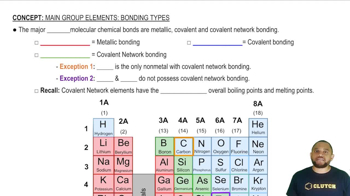
Compounds can be classified based on the types of bonds they contain: ionic, covalent, or polar covalent. Ionic compounds typically form between metals and nonmetals, while covalent compounds form between nonmetals. Recognizing the nature of the bonds in each compound listed in the question is essential for ordering them by increasing ionic character.
Video consigliato: