Ch.7 - Covalent Bonding and Electron-Dot Structures
McMurry - Chemistry 8th Edition
McMurry8th EditionChemistryISBN: 9781292336145Non è quello che usi tu?Cambia libro di testo
Capitolo 7, Problema 50

Which of the following substances contain bonds that are largely ionic? (a) HF (b) HI (c) PdCl2 (d) BBr3 (e) NaOH (f) CH3Li

Guida verificata passo dopo passo
1
insert step 1> Identify the nature of the bond in each compound by considering the elements involved and their positions in the periodic table.
insert step 2> Recall that ionic bonds typically form between metals and nonmetals, where there is a significant difference in electronegativity.
insert step 3> For each compound, determine the type of elements present: metals, nonmetals, or metalloids.
insert step 4> Compare the electronegativity of the elements in each compound to assess whether the bond is likely to be ionic (large difference) or covalent (small difference).
insert step 5> Identify the compounds with the largest electronegativity differences, indicating largely ionic bonds.

Risposta video verificata per un problema simile:

Questa soluzione video è stata consigliata dai nostri tutor come utile per risolvere questo problema.
Durata del video:
3m

Concetti chiave

Ecco i concetti essenziali che devi comprendere per rispondere correttamente alla domanda.

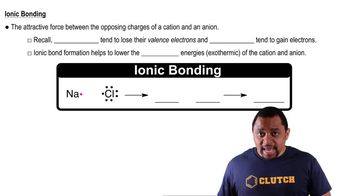
Ionic Bonds

Ionic bonds are formed when electrons are transferred from one atom to another, resulting in the formation of charged ions. Typically, this occurs between metals, which lose electrons and become positively charged, and nonmetals, which gain electrons and become negatively charged. The electrostatic attraction between these oppositely charged ions creates a strong bond, characteristic of ionic compounds.
Video consigliato:

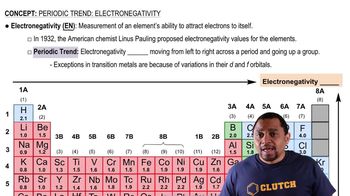
Electronegativity

Electronegativity is a measure of an atom's ability to attract and hold onto electrons in a chemical bond. The greater the difference in electronegativity between two bonded atoms, the more ionic the bond is considered to be. For example, a large difference indicates that one atom is likely to completely transfer an electron to the other, leading to the formation of ions.
Video consigliato:
Percorso guidato
02:10
Electronegativity Trends

Ionic vs. Covalent Compounds

Ionic compounds typically consist of a metal and a nonmetal, while covalent compounds are formed between nonmetals. Ionic compounds tend to have high melting and boiling points due to the strong attractions between ions, whereas covalent compounds usually have lower melting points. Understanding the nature of the bonding in a substance helps in predicting its properties and behavior in chemical reactions.
Video consigliato:
Percorso guidato
02:11
Ionic Compounds Naming