Ch.7 - Covalent Bonding and Electron-Dot Structures
McMurry - Chemistry 8th Edition
McMurry8th EditionChemistryISBN: 9781292336145Non è quello che usi tu?Cambia libro di testo
Capitolo 7, Problema 52

Show the direction of polarity for each of the bonds in Problem 7.51 using the notation. (b) Si-Li or Si-Cl

Guida verificata passo dopo passo
1
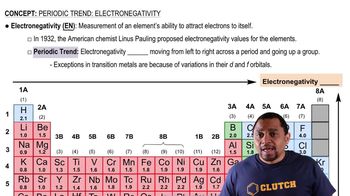
Identify the electronegativities of the atoms involved in each bond. Silicon (Si) has an electronegativity of about 1.90, Lithium (Li) has an electronegativity of about 0.98, and Chlorine (Cl) has an electronegativity of about 3.16.
Compare the electronegativities of the atoms in each bond. The atom with the higher electronegativity will attract the shared electrons more strongly.
For the Si-Li bond, since Si (1.90) is more electronegative than Li (0.98), the electrons in the bond will be more attracted towards Si. This makes Si partially negative (\(\delta-\)) and Li partially positive (\(\delta+\)).
For the Si-Cl bond, since Cl (3.16) is more electronegative than Si (1.90), the electrons in the bond will be more attracted towards Cl. This makes Cl partially negative (\(\delta-\)) and Si partially positive (\(\delta+\)).
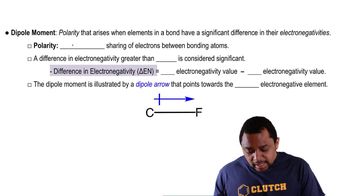
Use the \(\delta+\) and \(\delta-\) notation to indicate the direction of polarity for each bond. For Si-Li, the polarity arrow points from Li to Si (Li\(\delta+\) → Si\(\delta-\)). For Si-Cl, the polarity arrow points from Si to Cl (Si\(\delta+\) → Cl\(\delta-\)).

Risposta video verificata per un problema simile:

Questa soluzione video è stata consigliata dai nostri tutor come utile per risolvere questo problema.
Durata del video:
2m

Concetti chiave

Ecco i concetti essenziali che devi comprendere per rispondere correttamente alla domanda.

Electronegativity

Electronegativity is a measure of an atom's ability to attract and hold onto electrons in a chemical bond. The difference in electronegativity between two bonded atoms determines the polarity of the bond. For example, in a bond between silicon (Si) and chlorine (Cl), chlorine is more electronegative, leading to a polar bond where the electron density is skewed towards chlorine.
Video consigliato:
Percorso guidato
02:10
Electronegativity Trends

Polarity of Bonds

Polarity in chemical bonds arises when there is an unequal sharing of electrons between two atoms due to differences in their electronegativities. A polar bond has a dipole moment, represented by an arrow pointing from the less electronegative atom to the more electronegative atom. In the case of Si-Cl, the bond is polar, while Si-Li is less polar due to their closer electronegativities.
Video consigliato:
Percorso guidato
02:38
Molecular Polarity

Dipole Moment

A dipole moment is a vector quantity that represents the separation of positive and negative charges in a bond. It is calculated as the product of the charge and the distance between the charges. In polar bonds, the dipole moment indicates the direction of polarity, with the arrow pointing towards the more electronegative atom, thus illustrating the bond's polarity visually.
Video consigliato: