
Ch.8 - Covalent Compounds: Bonding Theories and Molecular Structure
McMurry - Chemistry 8th Edition
McMurry8th EditionChemistryISBN: 9781292336145Non è quello che usi tu?Cambia libro di testo
Capitolo 8, Problema 105

Calcium carbide, CaC2, reacts with water to produce acetylene, C2H2, and is sometimes used as a convenient source of that substance. Use the MO energy diagram in Figure 8.22a to describe the bonding in the carbide anion, C22-. What is its bond order?

Guida verificata passo dopo passo
1
Step 1: The carbide anion, C22-, is a diatomic molecule. In order to understand its bonding, we need to fill in the molecular orbital (MO) energy diagram. The MO energy diagram for a diatomic molecule like C22- consists of a series of energy levels representing bonding and antibonding molecular orbitals. The energy levels are filled with electrons starting from the lowest energy level.
Step 2: Each carbon atom has 6 electrons, so the C22- anion, which has two extra electrons, has a total of 14 electrons. Start filling in the MO energy diagram from the lowest energy level, which is the sigma 1s orbital, and continue to the higher energy levels. Each orbital can hold a maximum of 2 electrons.
Step 3: After filling in the sigma 1s, sigma* 1s, sigma 2s, and sigma* 2s orbitals, you will have 8 electrons left. These will fill the pi 2p and sigma 2p orbitals. The pi 2p orbitals can hold 4 electrons and the sigma 2p orbital can hold 2 electrons.
Step 4: To calculate the bond order, use the formula: Bond Order = 0.5 * (Number of electrons in bonding orbitals - Number of electrons in antibonding orbitals). In this case, the bonding orbitals are sigma 1s, sigma 2s, pi 2p, and sigma 2p, and the antibonding orbitals are sigma* 1s and sigma* 2s.
Step 5: Plug the number of electrons in the bonding and antibonding orbitals into the bond order formula to calculate the bond order of the C22- anion. A higher bond order indicates a stronger, more stable bond.

Risposta video verificata per un problema simile:

Questa soluzione video è stata consigliata dai nostri tutor come utile per risolvere questo problema.
Durata del video:
4m

Concetti chiave

Ecco i concetti essenziali che devi comprendere per rispondere correttamente alla domanda.

Molecular Orbital Theory

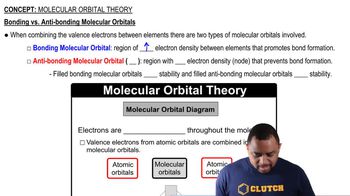
Molecular Orbital (MO) Theory explains how atomic orbitals combine to form molecular orbitals, which can be occupied by electrons. In this theory, bonding and antibonding orbitals are formed, and the distribution of electrons in these orbitals determines the stability and properties of the molecule. Understanding MO diagrams is crucial for analyzing the bonding characteristics of complex ions like the carbide anion.
Video consigliato:
Percorso guidato
03:06
Molecular Orbital Theory

Bond Order

Bond order is a measure of the number of chemical bonds between a pair of atoms, calculated as the difference between the number of bonding and antibonding electrons divided by two. It provides insight into the strength and stability of a bond; a higher bond order indicates a stronger bond. In the case of the carbide anion, determining the bond order helps assess the nature of the bonding between carbon atoms.
Video consigliato:
Percorso guidato
00:36
Average Bond Order

Carbide Anion Structure

The carbide anion, C2^2-, consists of two carbon atoms sharing electrons, resulting in a unique bonding arrangement. This anion can be analyzed using MO theory to understand its electronic configuration and stability. The structure and bonding characteristics of the carbide anion are essential for predicting its reactivity and the products formed during its reactions, such as with water.
Video consigliato:
Percorso guidato
01:42
Resonance Structures
Pratica correlata
Domanda del libro di testo
Look at the MO diagrams of corresponding neutral diatomic species in Figure 8.22, and predict whether each of the following ions is diamagnetic or paramagnetic. Diagrams for Li2 and C2 are similar to N2; Cl2 is similar to F2. (c) F2-
554
views
Domanda del libro di testo
Use the MO energy diagram in Figure 8.22b to describe the bonding in O2+, O2, and O2-. Which of the three is likely to be stable? What is the bond order of each? Which contain unpaired electrons?
991
views
Domanda del libro di testo

At high temperatures, sulfur vapor is predominantly in the form of S2(g) molecules. (a) Assuming that the molecular orbitals for third-row diatomic molecules are analogous to those for second-row molecules, construct an MO diagram for the valence orbitals of S2(g).

466
views
Domanda del libro di testo

Carbon monoxide is produced by incomplete combustion of fossil fuels. (a) Give the electron configuration for the valence molecular orbitals of CO. The orbitals have the same energy order as those of the N2 molecule.

346
views
Domanda del libro di testo
The C2 molecule can be represented by an MO diagram similar to that in Figure 8.22a. (b) To increase the bond order of C2, should you add or remove an electron?
1531
views
Domanda del libro di testo

At high temperatures, sulfur vapor is predominantly in the form of S2(g) molecules. (d) When two electrons are added to S2, the disulfide ion S22- is formed. Is the bond length in S22- likely to be shorter or longer than the bond length in S2? Explain.

513
views