
Ch.8 - Covalent Compounds: Bonding Theories and Molecular Structure
McMurry - Chemistry 8th Edition
McMurry8th EditionChemistryISBN: 9781292336145Non è quello che usi tu?Cambia libro di testo
Capitolo 8, Problema 102

Look at the MO diagrams of corresponding neutral diatomic species in Figure 8.22, and predict whether each of the following ions is diamagnetic or paramagnetic. Diagrams for Li2 and C2 are similar to N2; Cl2 is similar to F2. (c) F2-

Guida verificata passo dopo passo
1
Identify the electron configuration of the neutral F2 molecule by referring to the MO diagram similar to F2. In the case of F2, the molecular orbitals fill up to the π*2p orbitals.
Determine the total number of electrons in the F2- ion. Since F2- has an extra electron compared to the neutral F2 molecule, add one electron to the highest occupied molecular orbital (HOMO) of F2.
Place the extra electron in the next available molecular orbital in the MO diagram, which would be the π*2p orbital, making it partially filled.
Check for unpaired electrons in the molecular orbitals. A partially filled orbital indicates the presence of unpaired electrons.
Conclude whether F2- is diamagnetic or paramagnetic based on the presence of unpaired electrons. If there are unpaired electrons, the ion is paramagnetic; if all electrons are paired, the ion is diamagnetic.

Risposta video verificata per un problema simile:

Questa soluzione video è stata consigliata dai nostri tutor come utile per risolvere questo problema.
Durata del video:
2m

Concetti chiave

Ecco i concetti essenziali che devi comprendere per rispondere correttamente alla domanda.

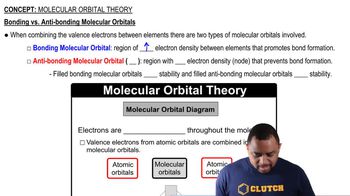
Molecular Orbital Theory

Molecular Orbital (MO) Theory describes how atomic orbitals combine to form molecular orbitals, which can be occupied by electrons. In this theory, electrons are delocalized over the entire molecule, and the energy levels of these orbitals determine the stability and magnetic properties of the molecule. Understanding the arrangement of electrons in these orbitals is crucial for predicting whether a species is diamagnetic or paramagnetic.
Video consigliato:
Percorso guidato
03:06
Molecular Orbital Theory

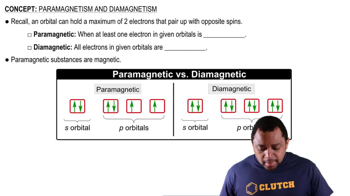
Diamagnetism and Paramagnetism

Diamagnetism is a property of materials that have all their electrons paired, resulting in no net magnetic moment and a weak repulsion from magnetic fields. In contrast, paramagnetism occurs in materials with unpaired electrons, leading to a net magnetic moment and attraction to magnetic fields. Identifying the electron configuration of a molecule or ion helps determine its magnetic properties based on the presence of unpaired electrons.
Video consigliato:
Percorso guidato
01:33
Paramagnetism and Diamagnetism

Electron Configuration of Ions

The electron configuration of an ion is derived from the neutral atom's configuration, adjusted for the gain or loss of electrons. For F2-, two additional electrons are added to the molecular orbitals compared to the neutral F2 molecule. Analyzing the resulting electron configuration allows us to assess the number of unpaired electrons, which is essential for determining whether the ion is diamagnetic or paramagnetic.
Video consigliato:
Percorso guidato
00:35
Anion Electron Configuration