
Ch.8 - Covalent Compounds: Bonding Theories and Molecular Structure
McMurry - Chemistry 8th Edition
McMurry8th EditionChemistryISBN: 9781292336145Non è quello che usi tu?Cambia libro di testo
Capitolo 8, Problema 107b

Carbon monoxide is produced by incomplete combustion of fossil fuels. (b) Do you expect CO to be paramagnetic or diamagnetic?

Guida verificata passo dopo passo
1
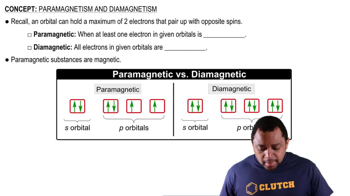
Understand the terms: Paramagnetic substances are attracted to magnetic fields due to unpaired electrons in their atomic or molecular structures, while diamagnetic substances are repelled by magnetic fields as all their electrons are paired.
Determine the electron configuration of carbon monoxide (CO). Carbon has an atomic number of 6 and oxygen has an atomic number of 8. In the CO molecule, these atoms share electrons.
Analyze the bonding in CO: CO has a triple bond between the carbon and oxygen atoms (one sigma bond and two pi bonds), and there is also a lone pair of electrons on the carbon.
Examine the molecular orbital diagram for CO, focusing on the highest occupied molecular orbital (HOMO) to check for the presence of unpaired electrons.
Conclude whether CO is paramagnetic or diamagnetic based on the presence or absence of unpaired electrons in the molecular orbitals.

Risposta video verificata per un problema simile:

Questa soluzione video è stata consigliata dai nostri tutor come utile per risolvere questo problema.
Durata del video:
3m

Concetti chiave

Ecco i concetti essenziali che devi comprendere per rispondere correttamente alla domanda.

Paramagnetism and Diamagnetism

Paramagnetism occurs in substances that have unpaired electrons, which create a net magnetic moment, allowing them to be attracted to magnetic fields. In contrast, diamagnetism is exhibited by substances with all paired electrons, resulting in no net magnetic moment, causing them to be weakly repelled by magnetic fields. Understanding these properties is essential for predicting the magnetic behavior of molecules.
Video consigliato:
Percorso guidato
01:33
Paramagnetism and Diamagnetism

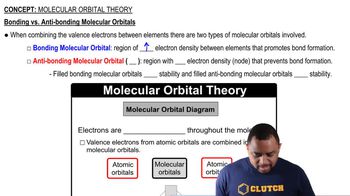
Molecular Orbital Theory

Molecular Orbital Theory explains how atomic orbitals combine to form molecular orbitals, which can be occupied by electrons. In this theory, electrons are distributed among bonding, antibonding, and non-bonding orbitals. The arrangement of electrons in these orbitals determines whether a molecule is paramagnetic or diamagnetic, based on the presence of unpaired electrons.
Video consigliato:
Percorso guidato
03:06
Molecular Orbital Theory

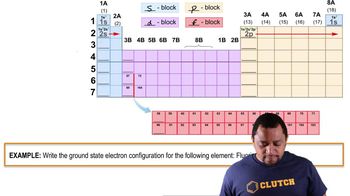
Electron Configuration of Carbon Monoxide (CO)

Carbon monoxide (CO) consists of one carbon atom and one oxygen atom, and its electron configuration can be analyzed using molecular orbital theory. In CO, the molecular orbitals are filled according to the Aufbau principle, leading to a configuration where there is one unpaired electron in a π* antibonding orbital. This unpaired electron is what makes CO paramagnetic, as it contributes to a net magnetic moment.
Video consigliato:
Percorso guidato
01:33
Electron Configuration Example