Ch.8 - Covalent Compounds: Bonding Theories and Molecular Structure
McMurry - Chemistry 8th Edition
McMurry8th EditionChemistryISBN: 9781292336145Non è quello che usi tu?Cambia libro di testo
Capitolo 8, Problema 55

Like cyclohexane (Problem 8.54), benzene also contains a sixmembered ring of carbon atoms, but it is flat rather than puckered. Explain, and predict the values of the C¬C¬C bond angles. Structural formula of benzene showing its flat six-membered carbon ring.

Guida verificata passo dopo passo
1
Step 1: Recognize that benzene (C6H6) is a planar molecule with a six-membered carbon ring.
Step 2: Understand that benzene has alternating double and single bonds between carbon atoms, known as conjugation, which leads to resonance stabilization.
Step 3: Note that the sp2 hybridization of each carbon atom in benzene results in a trigonal planar geometry around each carbon, with bond angles of 120 degrees.
Step 4: Compare this to cyclohexane, which is puckered to relieve angle strain, whereas benzene remains flat due to the delocalized π-electrons providing additional stability.
Step 5: Conclude that the C-C-C bond angles in benzene are predicted to be 120 degrees due to the sp2 hybridization and planar structure.

Risposta video verificata per un problema simile:

Questa soluzione video è stata consigliata dai nostri tutor come utile per risolvere questo problema.
Durata del video:
2m

Concetti chiave

Ecco i concetti essenziali che devi comprendere per rispondere correttamente alla domanda.

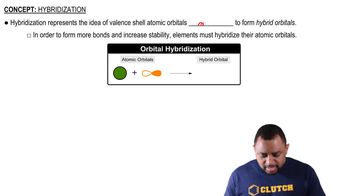
Hybridization

Hybridization is the concept that describes the mixing of atomic orbitals to form new hybrid orbitals, which can explain the geometry of molecular structures. In benzene, each carbon atom undergoes sp² hybridization, resulting in three sp² hybrid orbitals that form sigma bonds with adjacent carbon atoms and hydrogen atoms, while the remaining unhybridized p orbital contributes to the delocalized pi bonding system.
Video consigliato:

Planarity of Benzene

Benzene is a planar molecule due to the sp² hybridization of its carbon atoms, which allows for the formation of a flat, cyclic structure. The arrangement minimizes steric strain and maximizes overlap of p orbitals, leading to resonance stabilization. This planarity is crucial for the delocalization of electrons, which contributes to benzene's unique stability and reactivity.
Video consigliato:
Percorso guidato
01:13
Benzene Reactions

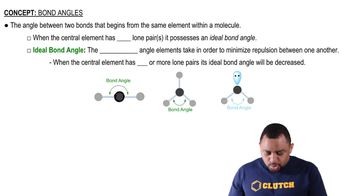
Bond Angles in Benzene

In benzene, the C-C-C bond angles are predicted to be approximately 120 degrees due to the trigonal planar arrangement of the sp² hybridized carbon atoms. This angle is characteristic of sp² hybridization, where the orbitals are arranged to minimize electron pair repulsion, resulting in a flat structure that supports the delocalization of pi electrons across the ring.
Video consigliato: