Ch.8 - Covalent Compounds: Bonding Theories and Molecular Structure
McMurry - Chemistry 8th Edition
McMurry8th EditionChemistryISBN: 9781292336145Non è quello che usi tu?Cambia libro di testo
Capitolo 8, Problema 57

Draw an electron-dot structure for each of the following substances, and predict the molecular geometry of every nonterminal atom. (a) F3S¬S¬F

Guida verificata passo dopo passo
1
Identify the central atom in the molecule. In F3S-S-F, sulfur (S) atoms are connected to each other, so each sulfur atom will be a central atom for its respective groups.
Count the total number of valence electrons available for bonding. Sulfur has 6 valence electrons and fluorine has 7 valence electrons. The total for F3S-S-F is 6(S) + 7(F) * 3 + 6(S) + 7(F) = 40 electrons.
Draw a skeleton structure by connecting the central atoms with a single bond and then arrange the fluorine atoms around the sulfur atoms. Each sulfur will bond with fluorine atoms and the other sulfur.
Distribute the remaining electrons as lone pairs on the outer atoms (fluorine) to complete their octet and then place any remaining electrons on the central atoms (sulfur).
Predict the molecular geometry of each nonterminal sulfur atom using the VSEPR theory. The electron pair geometry around each sulfur is based on the number of bonding pairs and lone pairs. Determine the molecular shape by considering the repulsion between these electron pairs.

Risposta video verificata per un problema simile:

Questa soluzione video è stata consigliata dai nostri tutor come utile per risolvere questo problema.
Durata del video:
4m

Concetti chiave

Ecco i concetti essenziali che devi comprendere per rispondere correttamente alla domanda.

Electron-Dot Structures

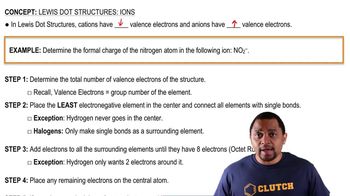
Electron-dot structures, also known as Lewis structures, represent the valence electrons of atoms within a molecule. They illustrate how electrons are shared or transferred between atoms, helping to visualize bonding and lone pairs. In the case of F3S¬S¬F, understanding the arrangement of fluorine and sulfur atoms is crucial for predicting molecular geometry.
Video consigliato:
Percorso guidato
04:28
Lewis Dot Structures: Ions

Molecular Geometry

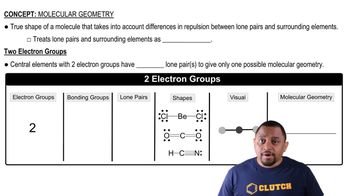
Molecular geometry refers to the three-dimensional arrangement of atoms in a molecule. It is determined by the number of bonding pairs and lone pairs of electrons around the central atom, following the VSEPR (Valence Shell Electron Pair Repulsion) theory. For F3S¬S¬F, identifying the geometry around the sulfur atoms is essential for understanding the overall shape of the molecule.
Video consigliato:
Percorso guidato
01:33
Molecular Geometry with Two Electron Groups

VSEPR Theory

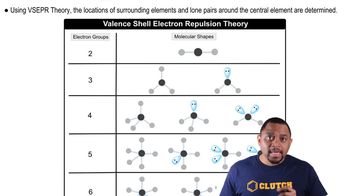
VSEPR theory posits that electron pairs around a central atom will arrange themselves to minimize repulsion, leading to specific molecular shapes. This theory helps predict the geometry of molecules based on the number of bonding and non-bonding electron pairs. In the case of F3S¬S¬F, applying VSEPR will allow for the prediction of the angles and arrangement of the sulfur and fluorine atoms.
Video consigliato:
Percorso guidato
02:13
Molecular Shapes and VSEPR