Ch.8 - Covalent Compounds: Bonding Theories and Molecular Structure
McMurry - Chemistry 8th Edition
McMurry8th EditionChemistryISBN: 9781292336145Non è quello che usi tu?Cambia libro di testo
Capitolo 8, Problema 60

What hybridization do you expect for atoms that have the following numbers of charge clouds? (c) 4

Guida verificata passo dopo passo
1
Identify the number of charge clouds around the atom, which in this case is 4.
Recall that charge clouds can be lone pairs, single bonds, double bonds, or triple bonds, each counting as one charge cloud.
Understand that the hybridization of an atom is determined by the number of charge clouds surrounding it. For 4 charge clouds, the hybridization involves the mixing of one s orbital and three p orbitals.
Combine the one s orbital and three p orbitals to form four sp^3 hybrid orbitals.
Conclude that an atom with 4 charge clouds exhibits sp^3 hybridization.

Risposta video verificata per un problema simile:

Questa soluzione video è stata consigliata dai nostri tutor come utile per risolvere questo problema.
Durata del video:
1m

Concetti chiave

Ecco i concetti essenziali che devi comprendere per rispondere correttamente alla domanda.

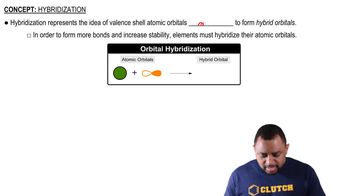
Hybridization

Hybridization is a concept in chemistry that describes the mixing of atomic orbitals to form new hybrid orbitals. These hybrid orbitals are used to explain the geometry of molecular bonding. The type of hybridization depends on the number of charge clouds (regions of electron density) around a central atom, which influences the shape and bond angles of the molecule.
Video consigliato:

Charge Clouds

Charge clouds refer to regions around a central atom where electrons are likely to be found. These can be lone pairs, single bonds, or multiple bonds. The number of charge clouds determines the hybridization of the atom, as it influences the spatial arrangement of the orbitals and the resulting molecular geometry.
Video consigliato:

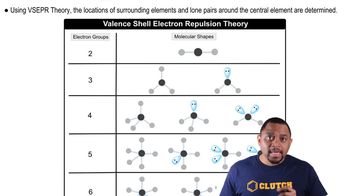
VSEPR Theory

Valence Shell Electron Pair Repulsion (VSEPR) Theory is a model used to predict the geometry of individual molecules based on the repulsion between electron pairs. According to VSEPR, electron pairs will arrange themselves as far apart as possible to minimize repulsion, which directly relates to the number of charge clouds and the resulting hybridization of the central atom.
Video consigliato:
Percorso guidato
02:13
Molecular Shapes and VSEPR