Ch.9 - Thermochemistry: Chemical Energy
McMurry - Chemistry 8th Edition
McMurry8th EditionChemistryISBN: 9781292336145Non è quello che usi tu?Cambia libro di testo
Capitolo 9, Problema 135

9.135 Suppose that a reaction has ΔH = + 41 kJ and ΔS = - 27 J/K. At what temperature, if any, will it change between spontaneous and nonspontaneous?

Guida verificata passo dopo passo
1
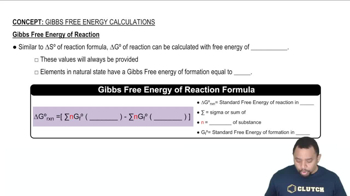
Step 1: Understand the relationship between Gibbs free energy (ΔG), enthalpy (ΔH), and entropy (ΔS) using the equation ΔG = ΔH - TΔS, where T is the temperature in Kelvin.
Step 2: Recognize that a reaction changes from spontaneous to nonspontaneous when ΔG = 0. This is the condition for equilibrium.
Step 3: Set the equation ΔG = ΔH - TΔS to zero and solve for the temperature T. This gives T = ΔH / ΔS.
Step 4: Convert the units of ΔS from J/K to kJ/K to match the units of ΔH. Since 1 kJ = 1000 J, divide ΔS by 1000.
Step 5: Substitute the values of ΔH and the converted ΔS into the equation T = ΔH / ΔS to find the temperature at which the reaction changes between spontaneous and nonspontaneous.

Concetti chiave

Ecco i concetti essenziali che devi comprendere per rispondere correttamente alla domanda.

Gibbs Free Energy

Gibbs Free Energy (G) is a thermodynamic potential that helps predict the spontaneity of a reaction. It is defined by the equation G = ΔH - TΔS, where ΔH is the change in enthalpy, T is the temperature in Kelvin, and ΔS is the change in entropy. A reaction is spontaneous when G is negative, indicating that the process can occur without external energy input.
Video consigliato:
Percorso guidato
01:51
Gibbs Free Energy of Reactions

Enthalpy and Entropy

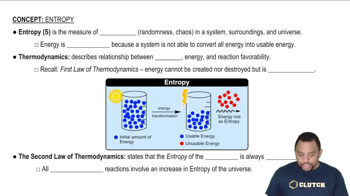
Enthalpy (ΔH) is a measure of the total heat content of a system, while entropy (ΔS) quantifies the disorder or randomness of a system. In the context of a reaction, a positive ΔH indicates that the reaction absorbs heat (endothermic), and a negative ΔS suggests a decrease in disorder. The interplay between these two factors determines the spontaneity of the reaction at a given temperature.
Video consigliato:
Percorso guidato
02:46
Entropy in Thermodynamics

Temperature and Spontaneity

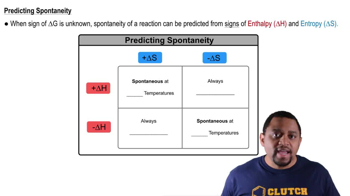
Temperature plays a crucial role in determining whether a reaction is spontaneous or nonspontaneous. The temperature at which a reaction changes from spontaneous to nonspontaneous can be found by setting the Gibbs Free Energy equation to zero (G = 0). This leads to the critical temperature T = ΔH/ΔS, allowing us to calculate the temperature at which the balance between enthalpy and entropy shifts.
Video consigliato:
Percorso guidato
01:17
Spontaneity and Temperature