Ch.9 - Thermochemistry: Chemical Energy
McMurry - Chemistry 8th Edition
McMurry8th EditionChemistryISBN: 9781292336145Non è quello che usi tu?Cambia libro di testo
Capitolo 9, Problema 107

Acetic acid (CH3CO2H), whose aqueous solutions are known as vinegar, is prepared by reaction of ethyl alcohol (CH3CH2OH) with oxygen: CH3CH2OH(l) + O2(g) → CH3CO2H(l) + H2O(l) Use the following data to calculate ∆H° in kilojoules for the reaction: ∆H°f [CH3CH2OH(l)] = -277.7 kJ/mol ∆H°f [CH3CO2H(l)] = -484.5 kJ/mol ∆H°f [H2O(l)] = -285.8 kJ/mol

Guida verificata passo dopo passo
1
Identify the reaction for which you need to calculate the enthalpy change (\( \Delta H^\circ \)). The reaction is: \( \text{CH}_3\text{CH}_2\text{OH}(l) + \text{O}_2(g) \rightarrow \text{CH}_3\text{CO}_2\text{H}(l) + \text{H}_2\text{O}(l) \).
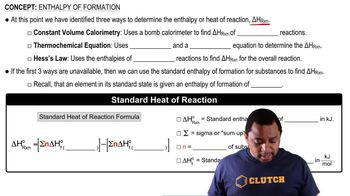
Use the formula for the standard enthalpy change of a reaction: \( \Delta H^\circ = \sum \Delta H^\circ_f(\text{products}) - \sum \Delta H^\circ_f(\text{reactants}) \).
List the standard enthalpy of formation (\( \Delta H^\circ_f \)) values for each substance involved: \( \Delta H^\circ_f [\text{CH}_3\text{CH}_2\text{OH}(l)] = -277.7 \text{ kJ/mol} \), \( \Delta H^\circ_f [\text{CH}_3\text{CO}_2\text{H}(l)] = -484.5 \text{ kJ/mol} \), \( \Delta H^\circ_f [\text{H}_2\text{O}(l)] = -285.8 \text{ kJ/mol} \).
Calculate the sum of the \( \Delta H^\circ_f \) values for the products: \( \Delta H^\circ_f [\text{CH}_3\text{CO}_2\text{H}(l)] + \Delta H^\circ_f [\text{H}_2\text{O}(l)] \).
Calculate the sum of the \( \Delta H^\circ_f \) values for the reactants: \( \Delta H^\circ_f [\text{CH}_3\text{CH}_2\text{OH}(l)] + \Delta H^\circ_f [\text{O}_2(g)] \). Note that the \( \Delta H^\circ_f \) for \( \text{O}_2(g) \) is 0 because it is in its standard state.

Risposta video verificata per un problema simile:

Questa soluzione video è stata consigliata dai nostri tutor come utile per risolvere questo problema.
Durata del video:
5m

Concetti chiave

Ecco i concetti essenziali che devi comprendere per rispondere correttamente alla domanda.

Enthalpy of Formation (∆H°f)

The enthalpy of formation (∆H°f) is the change in enthalpy when one mole of a compound is formed from its elements in their standard states. It is a crucial value in thermodynamics, allowing chemists to calculate the energy changes associated with chemical reactions. In this question, the ∆H°f values for the reactants and products are used to determine the overall enthalpy change for the reaction.
Video consigliato:
Percorso guidato
02:34
Enthalpy of Formation

Hess's Law

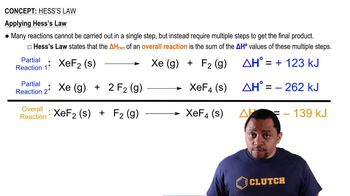
Hess's Law states that the total enthalpy change for a reaction is the sum of the enthalpy changes for the individual steps of the reaction, regardless of the pathway taken. This principle allows for the calculation of reaction enthalpies using standard enthalpy of formation values, as it simplifies the process of determining the heat change for complex reactions by breaking them down into simpler components.
Video consigliato:

Thermochemical Equations

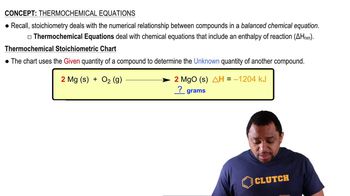
Thermochemical equations are balanced chemical equations that include the enthalpy change associated with the reaction. They provide a clear representation of the energy changes that occur during a reaction, allowing for the calculation of heat absorbed or released. In this context, the thermochemical equation for the reaction of ethyl alcohol with oxygen is essential for applying Hess's Law and calculating the overall ∆H°.
Video consigliato:
Percorso guidato
01:13
Thermochemical Equations
Pratica correlata
Domanda del libro di testo
Methyl tert-butyl ether (MTBE) is prepared by reaciton of methanol (l) (ΔH°f = -239.2 kJ/mol) with 2-methyl-propene (g), according to the requation Calculate ΔH°f in kJ/mol for 2-methylpropene
724
views

Domanda del libro di testo
Calculate ∆H°f in kJ/mol for benzene, C6H6, from the following data: 2 C6H6(l) + 15 O2(g) → 12 CO2(g) + 6 H2O(l) ∆H°=-6534 kJ ∆H°f (CO2) = -393.5 kJ/mol ∆H°f(H2O) = -285.8 kJ/mol
3469
views
1
rank
Domanda del libro di testo
Styrene (C8H8), the precursor of polystyrene polymers, has a standard heat of combustion of -4395 kJ/mol. Write a balanced equation for the combustion reaction, and calculate ΔH°f for styrene in kJ/mol. ΔH°f [CO2(g)] = -393.5 kJ/mol; ΔH°f [H2O(l)] = -285.8 kJ/mol
1133
views
Domanda del libro di testo
Methyl tert-butyl ether (MTBE), C5H12O, a gasoline additive used to boost octane ratings, has ΔH°f = -313.6 kJ/mol. Write a balanced equaiton for its combustion reaciton, and calcualte its standard heat of combustion in kilojoules
1143
views
Domanda del libro di testo
Sulfuric acid (H2SO4), the most widely produced chemical in the world, is amde yb a two-step oxidaiton of sulfur to sulfur trioxide, SO3, followed by reaciton with water. Calculate ΔH°f for SO3 in kJ/mol, given the following data: S(s) + O2(g) → SO2(g) ΔH° = -296.8 kJ SO2(g) + 1/2 O2(g) → SO3(g) ΔH° = -98.9 kJ
1124
views
Domanda del libro di testo
The standard enthalpy change for the reaciton of SO3(g) with H2O(l) to yield H2SO4(aq) is ΔH° = -227.8 kJ. Use the information in Problem 9.104 to calculate ΔH°f for H2SO4(aq) in kJ/mol. [For H2O(l), ΔH°f = -285.88 kJ/mol.]
3138
views