Ch.9 - Thermochemistry: Chemical Energy
McMurry - Chemistry 8th Edition
McMurry8th EditionChemistryISBN: 9781292336145Non è quello che usi tu?Cambia libro di testo
Capitolo 9, Problema 122

What does entropy measure?

Guida verificata passo dopo passo
1
Entropy is a measure of the disorder or randomness in a system.
In thermodynamics, it quantifies the number of possible microscopic configurations that correspond to a thermodynamic system's macroscopic state.
The second law of thermodynamics states that the total entropy of an isolated system can never decrease over time.
Entropy is often associated with the amount of information that is missing from our knowledge of the complete microstate of the system.
In chemical reactions, an increase in entropy often corresponds to a greater dispersal of energy and matter, such as when a solid dissolves in a liquid or a gas expands.

Risposta video verificata per un problema simile:

Questa soluzione video è stata consigliata dai nostri tutor come utile per risolvere questo problema.
Durata del video:
1m

Concetti chiave

Ecco i concetti essenziali che devi comprendere per rispondere correttamente alla domanda.

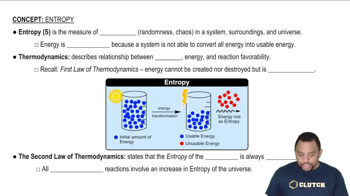
Entropy

Entropy is a thermodynamic quantity that measures the degree of disorder or randomness in a system. It reflects the number of possible microscopic configurations that correspond to a thermodynamic system's macroscopic state. Higher entropy indicates greater disorder and a higher number of configurations, while lower entropy suggests more order and fewer configurations.
Video consigliato:
Percorso guidato
02:46
Entropy in Thermodynamics

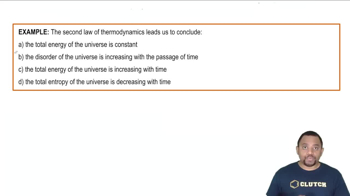
Second Law of Thermodynamics

The Second Law of Thermodynamics states that in any energy transfer or transformation, the total entropy of an isolated system can never decrease over time. This principle implies that natural processes tend to move towards a state of maximum disorder or equilibrium, making entropy a key factor in predicting the direction of spontaneous processes.
Video consigliato:
Percorso guidato
00:48
Second Law of Thermodynamics Example

Statistical Mechanics

Statistical mechanics is a branch of physics that connects the microscopic properties of individual atoms and molecules to the macroscopic properties of materials. It provides a framework for understanding how the collective behavior of particles leads to observable phenomena like temperature and entropy, allowing for a deeper insight into the nature of thermodynamic systems.
Video consigliato:
Percorso guidato
03:06
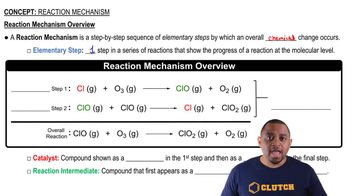
Reaction Mechanism Overview