Ch.1 - Matter, Measurement & Problem Solving
Tro - Chemistry: A Molecular Approach 4th Edition
Tro4th EditionChemistry: A Molecular ApproachISBN: 9780134112831Non è quello che usi tu?Cambia libro di testo
Capitolo 1, Problema 59d

Complete the table. d. 3.345 kJ _____J _____mJ

Guida verificata passo dopo passo
1
Step 1: Understand the units involved. We are converting kilojoules (kJ) to joules (J) and millijoules (mJ).
Step 2: Recall the conversion factors: 1 kJ = 1000 J and 1 J = 1000 mJ.
Step 3: Convert 3.345 kJ to joules by multiplying by the conversion factor: 3.345 kJ * 1000 J/kJ.
Step 4: Convert the result from joules to millijoules by multiplying by the conversion factor: result in J * 1000 mJ/J.
Step 5: Fill in the table with the calculated values for joules and millijoules.

Risposta video verificata per un problema simile:

Questa soluzione video è stata consigliata dai nostri tutor come utile per risolvere questo problema.
Durata del video:
57s

Concetti chiave

Ecco i concetti essenziali che devi comprendere per rispondere correttamente alla domanda.

Energy Units

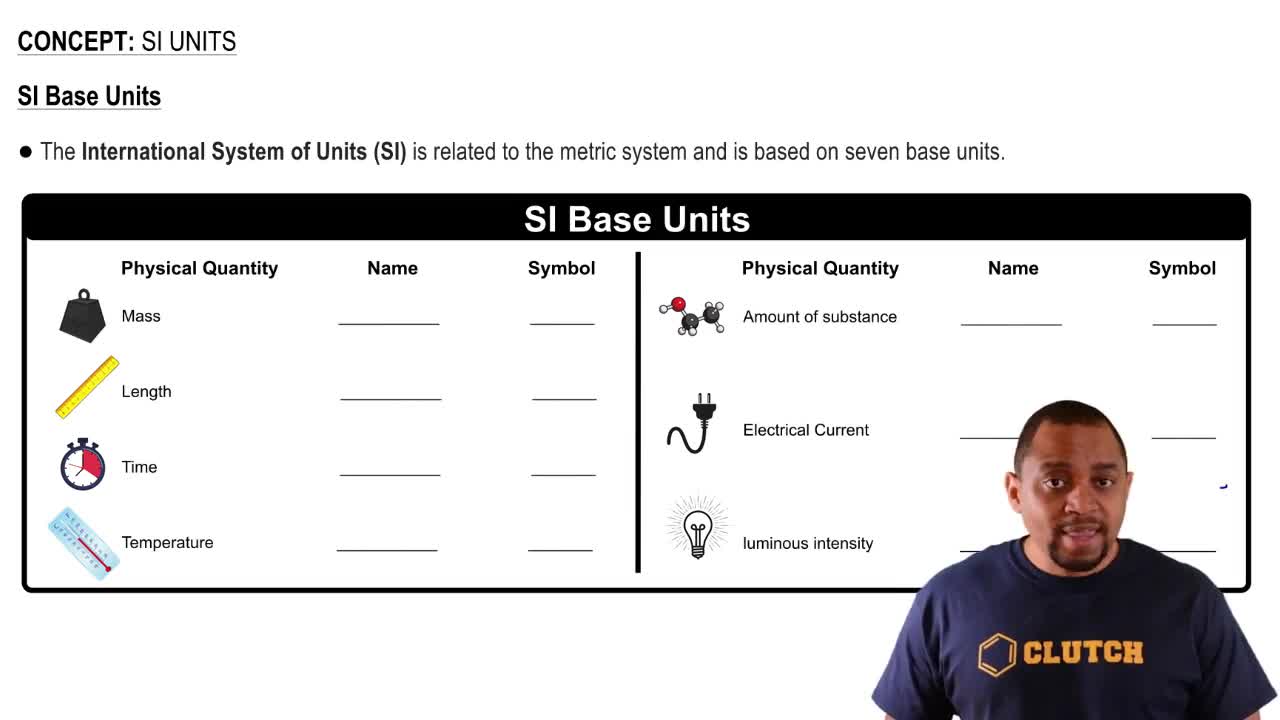
Energy can be measured in various units, with the joule (J) being the standard SI unit. Other common units include kilojoules (kJ) and millijoules (mJ), where 1 kJ equals 1,000 J and 1 mJ equals 0.001 J. Understanding these conversions is essential for accurately completing the table.
Video consigliato:

Unit Conversion

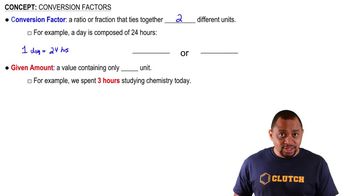
Unit conversion involves changing a quantity expressed in one unit to another unit. This process requires knowledge of conversion factors, such as knowing that to convert kJ to J, you multiply by 1,000, and to convert J to mJ, you multiply by 1,000. Mastery of these conversions is crucial for solving problems involving energy.
Video consigliato:
Percorso guidato
01:56
Conversion Factors

Dimensional Analysis

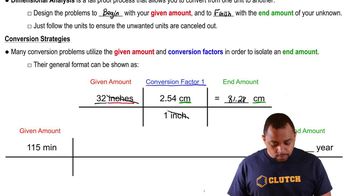
Dimensional analysis is a mathematical technique used to convert one set of units to another. It involves multiplying by conversion factors that equal one, ensuring that the units cancel appropriately. This method is particularly useful in chemistry for ensuring that calculations involving different units yield correct results.
Video consigliato:
Percorso guidato
06:11
Dimensional Analysis