Ch.1 - Matter, Measurement & Problem Solving
Tro - Chemistry: A Molecular Approach 4th Edition
Tro4th EditionChemistry: A Molecular ApproachISBN: 9780134112831Non è quello che usi tu?Cambia libro di testo
Capitolo 1, Problema 59a

Complete the table. a. 1245 kg _ 1.245×10⁶ g _ 1.245×10⁹ mg

Guida verificata passo dopo passo
1
Step 1: Understand the problem. You need to convert the given mass in kilograms (kg) to grams (g) and milligrams (mg).
Step 2: Recall the conversion factors. 1 kg = 1000 g and 1 g = 1000 mg.
Step 3: Convert kilograms to grams. Multiply the mass in kilograms by 1000 to get the mass in grams.
Step 4: Convert grams to milligrams. Multiply the mass in grams by 1000 to get the mass in milligrams.
Step 5: Verify your conversions by checking if the units cancel out correctly and ensure the final units are in grams and milligrams.

Risposta video verificata per un problema simile:

Questa soluzione video è stata consigliata dai nostri tutor come utile per risolvere questo problema.
Durata del video:
1m

Concetti chiave

Ecco i concetti essenziali che devi comprendere per rispondere correttamente alla domanda.

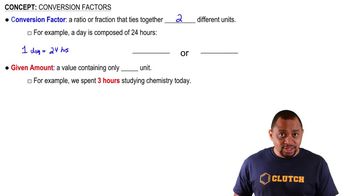
Unit Conversion

Unit conversion is the process of converting a quantity expressed in one unit to another unit. In chemistry, this often involves converting between mass units such as kilograms, grams, and milligrams. Understanding the relationships between these units is essential, as 1 kg equals 1000 g and 1 g equals 1000 mg, allowing for accurate conversions.
Video consigliato:
Percorso guidato
01:56
Conversion Factors

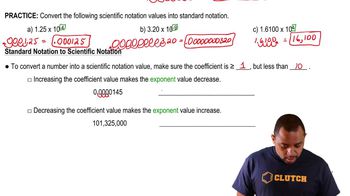
Scientific Notation

Scientific notation is a way of expressing very large or very small numbers in a compact form, using powers of ten. For example, 1.245 * 10^6 represents 1,245,000. This notation simplifies calculations and comparisons, especially in chemistry where quantities can vary significantly in scale.
Video consigliato:
Percorso guidato
02:50
Standard Notation to Scientific Notation

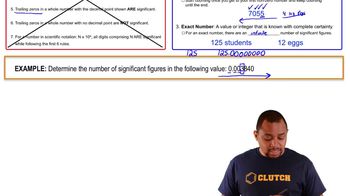
Significant Figures

Significant figures are the digits in a number that contribute to its precision. In scientific measurements, it is important to report results with the correct number of significant figures to reflect the accuracy of the measurement. This concept is crucial when performing calculations involving conversions, as it ensures that the final answer is not misleading.
Video consigliato:
Percorso guidato
01:09
Significant Figures Example