Ch.10 - Chemical Bonding II: Molecular Shapes & Valence Bond Theory
Tro - Chemistry: A Molecular Approach 4th Edition
Tro4th EditionChemistry: A Molecular ApproachISBN: 9780134112831Non è quello che usi tu?Cambia libro di testo
Capitolo 10, Problema 92a

Draw Lewis structures and MO diagrams for CN+ , CN, and CN- . According to the Lewis model, which species is most stable?

Guida verificata passo dopo passo
1
Draw the Lewis structure for CN^+ by counting the total number of valence electrons. Carbon has 4 valence electrons and nitrogen has 5, but since there is a positive charge, subtract one electron. Distribute these electrons to satisfy the octet rule.
Draw the Lewis structure for CN by counting the total number of valence electrons. Carbon has 4 valence electrons and nitrogen has 5, making a total of 9 electrons. Distribute these electrons to satisfy the octet rule.
Draw the Lewis structure for CN^- by counting the total number of valence electrons. Carbon has 4 valence electrons and nitrogen has 5, but since there is a negative charge, add one electron. Distribute these electrons to satisfy the octet rule.
Construct the molecular orbital (MO) diagram for each species. Start by identifying the atomic orbitals of carbon and nitrogen, then combine them to form bonding and antibonding molecular orbitals. Fill the molecular orbitals with the appropriate number of electrons for CN^+, CN, and CN^-.
Compare the stability of CN^+, CN, and CN^- using the Lewis structures and MO diagrams. Consider factors such as the number of bonds, formal charges, and bond order to determine which species is most stable.

Risposta video verificata per un problema simile:

Questa soluzione video è stata consigliata dai nostri tutor come utile per risolvere questo problema.
Durata del video:
15m

Concetti chiave

Ecco i concetti essenziali che devi comprendere per rispondere correttamente alla domanda.

Lewis Structures

Lewis structures are diagrams that represent the bonding between atoms in a molecule and the lone pairs of electrons that may exist. They use dots to represent valence electrons and lines to represent bonds between atoms. Understanding how to draw Lewis structures is essential for predicting the arrangement of electrons and the overall stability of a molecule.
Video consigliato:
Percorso guidato
04:28
Lewis Dot Structures: Ions

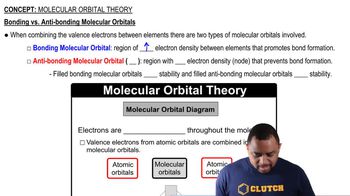
Molecular Orbital (MO) Theory

Molecular Orbital Theory describes the behavior of electrons in a molecule by considering the combination of atomic orbitals to form molecular orbitals. These orbitals can be bonding, antibonding, or non-bonding, and their occupancy determines the stability and reactivity of the molecule. MO diagrams visually represent these orbitals and their energy levels, providing insight into the electronic structure of the species.
Video consigliato:
Percorso guidato
03:06
Molecular Orbital Theory

Stability of Ions

The stability of ions, such as CN+, CN, and CN-, is influenced by factors like formal charge, electron configuration, and the presence of lone pairs. Generally, species with a formal charge close to zero and a full valence shell are more stable. Analyzing the Lewis structures and MO diagrams helps determine which ion has the most favorable electronic arrangement, thus indicating its stability.
Video consigliato:
Percorso guidato
03:13
Intepreting the Band of Stability