Ch.10 - Chemical Bonding II: Molecular Shapes & Valence Bond Theory
Tro - Chemistry: A Molecular Approach 4th Edition
Tro4th EditionChemistry: A Molecular ApproachISBN: 9780134112831Non è quello che usi tu?Cambia libro di testo
Capitolo 10, Problema 89c

Most vitamins can be classified as either fat soluble, which results in their tendency to accumulate in the body (so that taking too much can be harmful), or water soluble, which results in their tendency to be quickly eliminated from the body in urine. Examine the structural formulas and space-filling models of these vitamins and determine whether each one is fat soluble (mostly nonpolar) or water soluble (mostly polar). (c) niacin (vitamin B3)

Guida verificata passo dopo passo
1
Identify the functional groups present in the structure of niacin (vitamin B3). Look for groups such as hydroxyl (-OH), carboxyl (-COOH), amine (-NH2), etc.
Assess the overall polarity of niacin based on the presence and distribution of these polar functional groups versus hydrophobic (nonpolar) components like hydrocarbon chains.
Consider the solubility characteristics: compounds with more polar functional groups are generally more water soluble, while those with more nonpolar characteristics are typically more fat soluble.
Evaluate the ratio of polar to nonpolar groups in niacin to determine its solubility. A higher proportion of polar groups suggests higher water solubility.
Conclude whether niacin is predominantly water soluble or fat soluble based on the predominance of polar or nonpolar groups in its structure.

Risposta video verificata per un problema simile:

Questa soluzione video è stata consigliata dai nostri tutor come utile per risolvere questo problema.
Durata del video:
1m

Concetti chiave

Ecco i concetti essenziali che devi comprendere per rispondere correttamente alla domanda.

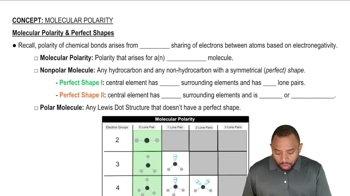
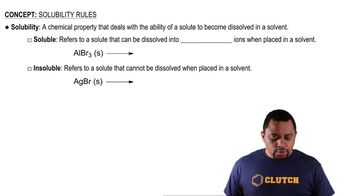
Solubility and Polarity

Solubility refers to the ability of a substance to dissolve in a solvent, which is largely determined by the polarity of the molecules involved. Polar molecules, which have uneven distribution of charge, tend to dissolve well in polar solvents like water, while nonpolar molecules, with even charge distribution, are more soluble in nonpolar solvents like fats. Understanding this concept is crucial for classifying vitamins based on their solubility.
Video consigliato:
Percorso guidato
02:38
Molecular Polarity

Fat-Soluble vs. Water-Soluble Vitamins

Vitamins are categorized into two groups based on their solubility: fat-soluble vitamins (A, D, E, K) are stored in the body's fatty tissues and can accumulate to toxic levels, while water-soluble vitamins (B-complex and C) are not stored and are excreted in urine. This classification affects their absorption, storage, and potential toxicity, making it essential to understand when analyzing specific vitamins like niacin.
Video consigliato:
Percorso guidato
02:07
Solubility and Insolubility

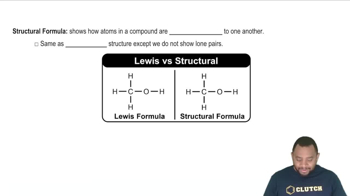
Structural Formulas and Space-Filling Models

Structural formulas depict the arrangement of atoms within a molecule, while space-filling models provide a three-dimensional representation of the molecule's size and shape. Analyzing these models helps in understanding the molecular characteristics that influence a vitamin's solubility, such as the presence of polar functional groups or hydrophobic regions, which are key to determining whether niacin is fat-soluble or water-soluble.
Video consigliato:
Percorso guidato
01:00
Structural Formula