
Ch.10 - Chemical Bonding II: Molecular Shapes & Valence Bond Theory
Tro - Chemistry: A Molecular Approach 4th Edition
Tro4th EditionChemistry: A Molecular ApproachISBN: 9780134112831Non è quello che usi tu?Cambia libro di testo
Capitolo 10, Problema 77a,b,c,d

Use molecular orbital theory to predict if each molecule or ion exists in a relatively stable form. a. H22- b. Ne2 c. He22+ d. F22-

Guida verificata passo dopo passo
1
Identify the total number of electrons in the molecule or ion. For \( \text{H}_2^{2-} \), each hydrogen atom contributes 1 electron, and the 2- charge adds 2 more electrons, giving a total of 4 electrons.
Write the molecular orbital (MO) configuration for the molecule. For \( \text{H}_2^{2-} \), the electrons will fill the molecular orbitals in the order: \( \sigma_{1s} \), \( \sigma_{1s}^* \).
Fill the molecular orbitals with the 4 electrons: \( \sigma_{1s}^2 \sigma_{1s}^*^2 \).
Calculate the bond order using the formula: \( \text{Bond Order} = \frac{(\text{Number of electrons in bonding MOs} - \text{Number of electrons in antibonding MOs})}{2} \).
Determine the stability of the molecule based on the bond order. A positive bond order indicates a stable molecule, while a bond order of zero or negative suggests instability.

Risposta video verificata per un problema simile:

Questa soluzione video è stata consigliata dai nostri tutor come utile per risolvere questo problema.
Durata del video:
8m

Concetti chiave

Ecco i concetti essenziali che devi comprendere per rispondere correttamente alla domanda.

Molecular Orbital Theory

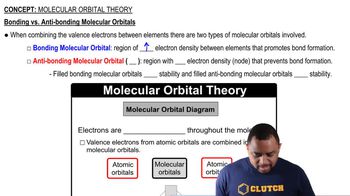
Molecular Orbital Theory (MOT) describes the behavior of electrons in molecules by combining atomic orbitals to form molecular orbitals. These orbitals can be bonding, antibonding, or non-bonding, and the distribution of electrons among them determines the stability and properties of the molecule. In this theory, the stability of a molecule is assessed by the number of electrons in bonding versus antibonding orbitals.
Video consigliato:
Percorso guidato
03:06
Molecular Orbital Theory

Bonding and Antibonding Orbitals

Bonding orbitals are formed when atomic orbitals combine constructively, leading to increased electron density between nuclei and a stabilizing effect. Conversely, antibonding orbitals arise from destructive interference, resulting in decreased electron density between nuclei and instability. The relative occupancy of these orbitals is crucial for predicting the stability of a molecule or ion, as a higher number of electrons in bonding orbitals typically indicates greater stability.
Video consigliato:
Percorso guidato
03:06
Molecular Orbital Theory

Electron Configuration in Ions

The electron configuration of ions reflects the distribution of electrons in molecular orbitals after accounting for the charge. For the H22- ion, two additional electrons must be considered, which will occupy the available molecular orbitals. Analyzing the resulting electron configuration helps determine whether the ion is stable, based on the balance between bonding and antibonding electrons.
Video consigliato:
Percorso guidato
00:35
Anion Electron Configuration
Pratica correlata
Domanda del libro di testo

Using the molecular orbital energy ordering for second-row homonuclear diatomic molecules in which the π2p orbitals lie at higher energy than the σ2p, draw MO energy diagrams and predict the bond order in a molecule or ion with each number of total valence electrons. Will the molecule or ion be diamagnetic or paramagnetic? c. 13

1821
views
Domanda del libro di testo

Using the molecular orbital energy ordering for second-row homonuclear diatomic molecules in which the π2p orbitals lie at higher energy than the σ2p, draw MO energy diagrams and predict the bond order in a molecule or ion with each number of total valence electrons. Will the molecule or ion be diamagnetic or paramagnetic? a. 10

459
views
Domanda del libro di testo

Using the molecular orbital energy ordering for second-row homonuclear diatomic molecules in which the π2p orbitals lie at higher energy than the σ2p, draw MO energy diagrams and predict the bond order in a molecule or ion with each number of total valence electrons. Will the molecule or ion be diamagnetic or paramagnetic? d. 14

680
views
Domanda del libro di testo

According to MO theory, which molecule or ion has the highest bond order? O2, O2- , O22-

640
views
Domanda del libro di testo

According to MO theory, which molecule or ion has the highest bond order? C2, C2+ , C2- According to MO theory, which molecule or ion has the highest bond energy? According to MO theory, which molecule or ion has the shortest bond length?

Domanda del libro di testo

Apply molecular orbital theory to predict if each molecule or ion exists in a relatively stable form. a. C22+ b. Li2 c. Be22+ d. Li22-

2555
views