Determine the electron geometry, molecular geometry, and idealized bond angles for each molecule. In which cases do you expect deviations from the idealized bond angle? a. PF3 b. SBr2 c. CHCl3 d. CS2
Ch.10 - Chemical Bonding II: Molecular Shapes & Valence Bond Theory
Tro4th EditionChemistry: A Molecular ApproachISBN: 9780134112831Non è quello che usi tu?Cambia libro di testo
Tutti i libri di testo
Tro 4th Edition
Ch.10 - Chemical Bonding II: Molecular Shapes & Valence Bond Theory
Problema 38
Tro 4th Edition
Ch.10 - Chemical Bonding II: Molecular Shapes & Valence Bond Theory
Problema 38Capitolo 10, Problema 38
Which species has the smaller bond angle, ClO4- or ClO3- ? Explain.
Guida verificata passo dopo passo1
Identify the central atom in each species: ClO4^- and ClO3^- both have chlorine (Cl) as the central atom.
Determine the number of electron domains around the central atom: ClO4^- has four oxygen atoms bonded to Cl, while ClO3^- has three oxygen atoms and one lone pair on Cl.
Use VSEPR theory to predict the molecular geometry: ClO4^- has a tetrahedral geometry, while ClO3^- has a trigonal pyramidal geometry due to the lone pair.
Recall that lone pairs repel more strongly than bonding pairs, causing bond angles to decrease in the presence of lone pairs.
Conclude that ClO3^- has a smaller bond angle than ClO4^- because the lone pair on ClO3^- causes greater repulsion, reducing the bond angle compared to the tetrahedral angle in ClO4^- which has no lone pairs.

Risposta video verificata per un problema simile:
Questa soluzione video è stata consigliata dai nostri tutor come utile per risolvere questo problema.
Durata del video:
2mConcetti chiave
Ecco i concetti essenziali che devi comprendere per rispondere correttamente alla domanda.
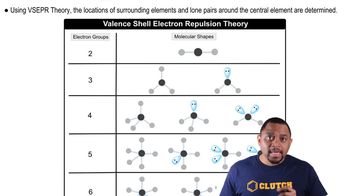
VSEPR Theory
Valence Shell Electron Pair Repulsion (VSEPR) Theory is a model used to predict the geometry of molecules based on the repulsion between electron pairs around a central atom. According to this theory, electron pairs, whether bonding or non-bonding, will arrange themselves to minimize repulsion, which directly influences bond angles.
Video consigliato:
Percorso guidato
Molecular Shapes and VSEPR
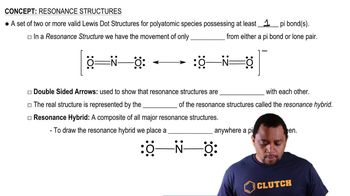
Resonance Structures
Resonance structures are different ways of drawing the same molecule that show the delocalization of electrons. In the case of ClO3- and ClO4-, resonance can affect the distribution of electron density and the overall geometry, which in turn influences the bond angles between the chlorine and oxygen atoms.
Video consigliato:
Percorso guidato
Resonance Structures
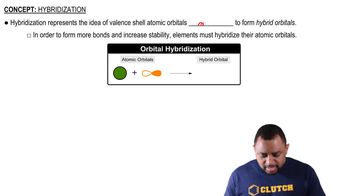
Hybridization
Hybridization is the concept of mixing atomic orbitals to form new hybrid orbitals that can accommodate bonding. The hybridization state of the central atom, chlorine in this case, determines the geometry and bond angles of the molecule. ClO4- is typically sp3 hybridized, while ClO3- can exhibit sp2 hybridization, leading to different bond angles.
Video consigliato:
Percorso guidato
Hybridization
Pratica correlata
Domanda del libro di testo
1624
views
1
comments
Domanda del libro di testo
Determine the electron geometry, molecular geometry, and idealized bond angles for each molecule. In which cases do you expect deviations from the idealized bond angle? a. CF4 b. NF3 c. OF2 d. H2S
1172
views
Domanda del libro di testo
Determine the molecular geometry and sketch each molecule or ion using the bond conventions shown in 'Representing Molecular Geometries on Paper' in Section 10.4. c. IF2-
469
views
Domanda del libro di testo
Which species has the smaller bond angle, H3O+ or H2O? Explain.
1068
views
Domanda del libro di testo
Determine the molecular geometry and sketch each molecule or ion using the bond conventions shown in 'Representing Molecular Geometries on Paper' in Section 10.4. d. IBr4-
778
views