Ch.13 - Solutions
Tro - Chemistry: A Molecular Approach 4th Edition
Tro4th EditionChemistry: A Molecular ApproachISBN: 9780134112831Non è quello che usi tu?Cambia libro di testo
Capitolo 13, Problema 33

For each compound, would you expect greater solubility in water or in hexane? Indicate the kinds of intermolecular forces that occur between the solute and the solvent in which the molecule is most soluble. a. glucose

Guida verificata passo dopo passo
1
Identify the polarity of glucose and hexane. Glucose is a polar molecule due to its numerous hydroxyl (OH) groups that can form hydrogen bonds. Hexane, on the other hand, is a nonpolar hydrocarbon with only London dispersion forces.
Consider the solubility principle 'like dissolves like'. Polar solutes tend to dissolve better in polar solvents, and nonpolar solutes dissolve better in nonpolar solvents.
Predict the solubility of glucose based on the principle from step 2. Since glucose is polar, it will be more soluble in water, which is also a polar solvent, compared to hexane, which is nonpolar.
Identify the intermolecular forces between glucose and water when glucose is dissolved. The primary intermolecular forces would be hydrogen bonding between the hydroxyl groups of glucose and the water molecules.
Conclude that glucose is more soluble in water due to the strong hydrogen bonds that can form with water, compared to the weak London dispersion forces that would occur between glucose and hexane.

Risposta video verificata per un problema simile:

Questa soluzione video è stata consigliata dai nostri tutor come utile per risolvere questo problema.
Durata del video:
1m

Concetti chiave

Ecco i concetti essenziali che devi comprendere per rispondere correttamente alla domanda.

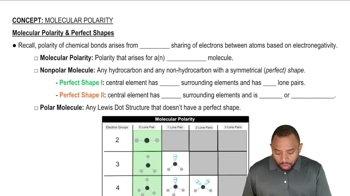
Polarity of Molecules

Polarity refers to the distribution of electrical charge over the atoms in a molecule. Polar molecules, like glucose, have regions of partial positive and negative charge due to differences in electronegativity between atoms. This property influences solubility, as polar substances tend to dissolve well in polar solvents like water, while nonpolar substances dissolve better in nonpolar solvents like hexane.
Video consigliato:
Percorso guidato
02:38
Molecular Polarity

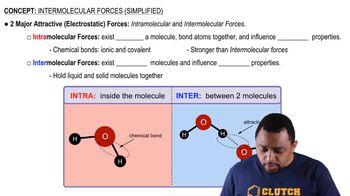
Intermolecular Forces

Intermolecular forces are the forces of attraction or repulsion between neighboring particles (atoms, molecules, or ions). In the case of glucose in water, hydrogen bonding is a significant intermolecular force, as glucose can form hydrogen bonds with water molecules. Understanding these forces helps predict solubility, as stronger interactions between solute and solvent lead to greater solubility.
Video consigliato:
Percorso guidato
01:59
Intermolecular vs Intramolecular Forces

Like Dissolves Like

The principle of 'like dissolves like' states that polar solvents dissolve polar solutes, and nonpolar solvents dissolve nonpolar solutes. This concept is crucial for predicting solubility; since glucose is a polar molecule, it is expected to be more soluble in water (a polar solvent) than in hexane (a nonpolar solvent). This principle helps in understanding the behavior of different compounds in various solvents.
Video consigliato:
Percorso guidato
02:14
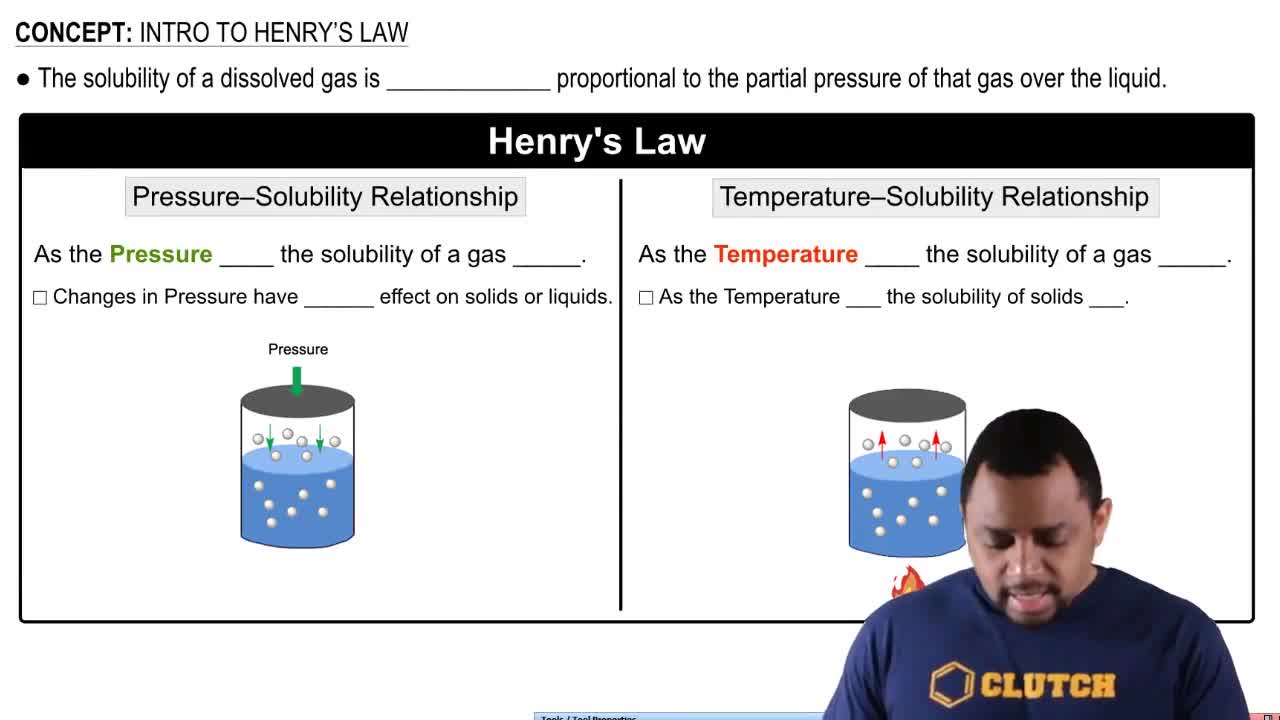
Henry's Law Solubility