Ch.13 - Solutions
Tro - Chemistry: A Molecular Approach 4th Edition
Tro4th EditionChemistry: A Molecular ApproachISBN: 9780134112831Non è quello che usi tu?Cambia libro di testo
Capitolo 13, Problema 55

Silver nitrate solutions are often used to plate silver onto other metals. What is the maximum amount of silver (in grams) that can be plated out of 4.8 L of an AgNO3 solution containing 3.4% Ag by mass? Assume that the density of the solution is 1.01 g/mL.

Guida verificata passo dopo passo
1
Step 1: First, we need to calculate the total mass of the solution. We can do this by multiplying the volume of the solution by its density. In this case, we have a volume of 4.8 L (which is equivalent to 4800 mL) and a density of 1.01 g/mL. So, the total mass of the solution is 4800 mL * 1.01 g/mL.
Step 2: Next, we need to find the mass of Ag in the solution. We know that the solution contains 3.4% Ag by mass. This means that for every 100 g of solution, there are 3.4 g of Ag. So, we can calculate the mass of Ag in the solution by multiplying the total mass of the solution by 3.4% (or 0.034).
Step 3: The result from step 2 will give us the mass of Ag in grams. This is the maximum amount of silver that can be plated out of the solution.
Step 4: Remember to check your units and make sure they are consistent throughout the problem. In this case, we started with volume in liters, converted it to milliliters, and then used the density to find the mass in grams.
Step 5: Finally, always review your work to ensure that it makes sense. The mass of Ag should be a reasonable value given the volume and concentration of the solution.

Risposta video verificata per un problema simile:

Questa soluzione video è stata consigliata dai nostri tutor come utile per risolvere questo problema.
Durata del video:
3m

Concetti chiave

Ecco i concetti essenziali che devi comprendere per rispondere correttamente alla domanda.

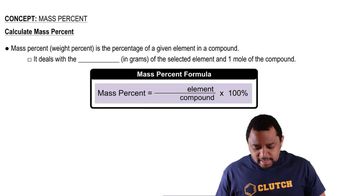
Concentration and Mass Percent

Mass percent is a way of expressing the concentration of a solute in a solution, calculated as the mass of the solute divided by the total mass of the solution, multiplied by 100. In this case, a 3.4% Ag by mass means that in every 100 grams of the solution, there are 3.4 grams of silver. Understanding this concept is crucial for determining the amount of silver present in the given volume of solution.
Video consigliato:
Percorso guidato
00:38
Mass Percent Calculation

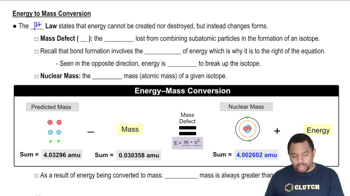
Volume to Mass Conversion

To find the mass of a solution from its volume, the density of the solution is used. Density is defined as mass per unit volume, and in this scenario, the density of the AgNO3 solution is given as 1.01 g/mL. By multiplying the volume of the solution (in mL) by its density, one can calculate the total mass of the solution, which is necessary for further calculations regarding the amount of silver.
Video consigliato:
Percorso guidato
04:12
Energy to Mass Conversion

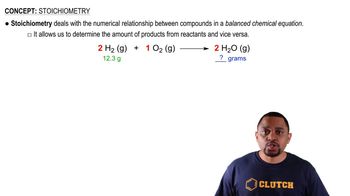
Stoichiometry in Chemical Reactions

Stoichiometry involves the calculation of reactants and products in chemical reactions based on the conservation of mass. In this context, it helps determine how much silver can be plated from the silver nitrate solution. By knowing the mass of silver in the solution, one can apply stoichiometric principles to find the maximum amount of silver that can be deposited onto another metal.
Video consigliato:
Percorso guidato
01:16
Stoichiometry Concept