
Anthropologists can estimate the age of a bone or other sample of organic matter by its carbon-14 content. The carbon-14 in a living organism is constant until the organism dies, after which carbon- 14 decays with first-order kinetics and a half-life of 5730 years. Suppose a bone from an ancient human contains 19.5% of the C-14 found in living organisms. How old is the bone?
Ch.14 - Chemical Kinetics
Tro4th EditionChemistry: A Molecular ApproachISBN: 9780134112831Non è quello che usi tu?Cambia libro di testo
Capitolo 14, Problema 105b
Consider the gas-phase reaction: H2(g) + I2(g) → 2 HI(g) The reaction was experimentally determined to be first order in H2 and first order in I2. Consider the proposed mechanisms. Proposed mechanism I: H2(g) + I2(g) → 2 HI(g) Single step Proposed mechanism II: I2(g) Δk1k-12 I(g) Fast H2( g) + 2 I( g) → k22 HI( g) Slow b. What kind of experimental evidence might lead you to favor mechanism II over mechanism I?
Guida verificata passo dopo passo1
Identify the rate law for the overall reaction based on the given information. Since the reaction is first order in both H2 and I2, the rate law is: rate = k[H2][I2].
Examine the proposed mechanisms. Mechanism I suggests a single-step reaction, which implies that the rate law should be derived directly from the stoichiometry of the reaction. This would mean the rate law is rate = k[H2][I2], which matches the experimental rate law.
Consider Mechanism II, which involves a fast equilibrium step followed by a slow step. The slow step is the rate-determining step, and the rate law for the overall reaction is determined by this step.
In Mechanism II, the slow step is H2 + 2 I → 2 HI. The rate law for this step would be rate = k2[H2][I]. However, since I is an intermediate, its concentration is determined by the fast equilibrium step: I2 ⇌ 2 I.
Use the equilibrium expression for the fast step to express [I] in terms of [I2]. The equilibrium constant expression is K = [I]^2 / [I2]. Solving for [I] gives [I] = sqrt(K[I2]). Substitute this into the rate law for the slow step to see if it matches the experimental rate law. If it does, this supports Mechanism II.

Risposta video verificata per un problema simile:
Questa soluzione video è stata consigliata dai nostri tutor come utile per risolvere questo problema.
Durata del video:
4mConcetti chiave
Ecco i concetti essenziali che devi comprendere per rispondere correttamente alla domanda.
Reaction Order
Reaction order refers to the power to which the concentration of a reactant is raised in the rate law of a chemical reaction. In this case, the reaction is first order in both H2 and I2, indicating that the rate of reaction is directly proportional to the concentration of each reactant. Understanding reaction order is crucial for analyzing how changes in concentration affect the reaction rate and for evaluating proposed mechanisms.
Video consigliato:
Percorso guidato
Average Bond Order
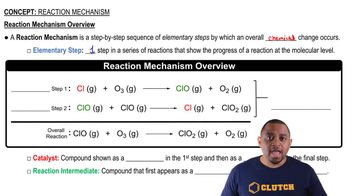
Mechanism of Reaction
A reaction mechanism is a step-by-step description of the pathway taken by reactants to form products. It includes elementary steps, which can be either fast or slow, and helps explain the overall reaction rate. In the context of the question, comparing the single-step mechanism I with the multi-step mechanism II allows for an understanding of how intermediates and rate-determining steps influence the observed kinetics.
Video consigliato:
Percorso guidato
Reaction Mechanism Overview
Rate-Determining Step
The rate-determining step (RDS) is the slowest step in a reaction mechanism that dictates the overall reaction rate. In proposed mechanism II, the slow step involves the formation of intermediates, which can significantly affect the kinetics of the reaction. Experimental evidence, such as changes in reaction rate with varying concentrations of reactants, can indicate whether the RDS aligns with the proposed mechanism, thus favoring one over the other.
Video consigliato:
Percorso guidato
Rate Law Determination
Pratica correlata
Domanda del libro di testo
2725
views
Domanda del libro di testo
Consider the reaction: 2 NH3(aq) + OCl-(aq) → N2H4(aq) + H2O(l) + Cl- (aq) This three-step mechanism is proposed: NH3(aq) + OCl- (aq) Δk1k2 NH2Cl(aq) + OH- (aq) Fast NH2Cl(aq) + NH3(aq) →k3 N2H5+ (aq) + Cl- (aq) Slow N2H5+ (aq) + OH-(aq) →k4 N2H4(aq) + H2O(l) Fast a. Show that the mechanism sums to the overall reaction.
878
views
Domanda del libro di testo
Consider the gas-phase reaction: H2(g) + I2(g) → 2 HI(g) The reaction was experimentally determined to be first order in H2 and first order in I2. Consider the proposed mechanisms. Proposed mechanism I: H2(g) + I2(g) → 2 HI(g) Single step Proposed mechanism II: I2(g) Δk1k-12 I(g) Fast H2( g) + 2 I( g) → k22 HI( g) Slow a. Show that both of the proposed mechanisms are valid.
650
views
