
Ch.14 - Chemical Kinetics
Tro - Chemistry: A Molecular Approach 4th Edition
Tro4th EditionChemistry: A Molecular ApproachISBN: 9780134112831Non è quello che usi tu?Cambia libro di testo
Capitolo 14, Problema 106a

Consider the reaction: 2 NH3(aq) + OCl-(aq) → N2H4(aq) + H2O(l) + Cl- (aq) This three-step mechanism is proposed: NH3(aq) + OCl- (aq) Δk1k2 NH2Cl(aq) + OH- (aq) Fast NH2Cl(aq) + NH3(aq) →k3 N2H5+ (aq) + Cl- (aq) Slow N2H5+ (aq) + OH-(aq) →k4 N2H4(aq) + H2O(l) Fast a. Show that the mechanism sums to the overall reaction.

Guida verificata passo dopo passo
1
Identify the reactants and products in each step of the mechanism.
Write down the reactants and products for each step: Step 1: NH_3(aq) + OCl^-(aq) \(\rightleftharpoons\) NH_2Cl(aq) + OH^-(aq), Step 2: NH_2Cl(aq) + NH_3(aq) \(\rightarrow\) N_2H_5^+(aq) + Cl^-(aq), Step 3: N_2H_5^+(aq) + OH^-(aq) \(\rightarrow\) N_2H_4(aq) + H_2O(l).
Add up all the reactants from each step and all the products from each step.
Cancel out any intermediates or species that appear on both sides of the equation.
Verify that the remaining reactants and products match the overall reaction: 2 NH_3(aq) + OCl^-(aq) \(\rightarrow\) N_2H_4(aq) + H_2O(l) + Cl^-(aq).

Risposta video verificata per un problema simile:

Questa soluzione video è stata consigliata dai nostri tutor come utile per risolvere questo problema.
Durata del video:
1m

Concetti chiave

Ecco i concetti essenziali che devi comprendere per rispondere correttamente alla domanda.

Reaction Mechanism

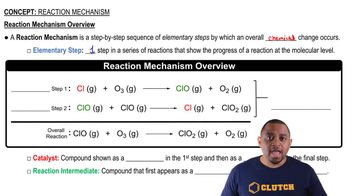
A reaction mechanism is a step-by-step description of the pathway taken during a chemical reaction. It outlines the individual elementary steps that lead to the overall reaction, including the formation and consumption of intermediates. Understanding the mechanism helps in predicting the rate and outcome of the reaction, as well as identifying the role of catalysts and inhibitors.
Video consigliato:
Percorso guidato
03:06
Reaction Mechanism Overview

Rate-Determining Step

The rate-determining step is the slowest step in a reaction mechanism that controls the overall reaction rate. It is crucial because the speed of this step dictates how quickly the entire reaction proceeds. In the provided mechanism, identifying the slow step allows for a better understanding of how the reaction progresses and how changes in conditions might affect the rate.
Video consigliato:
Percorso guidato
01:15
Rate Law Determination

Stoichiometry

Stoichiometry involves the calculation of reactants and products in chemical reactions based on the balanced equation. It ensures that the law of conservation of mass is upheld, meaning the number of atoms of each element must be the same on both sides of the equation. In this context, verifying that the sum of the elementary steps matches the overall reaction requires careful stoichiometric analysis.
Video consigliato:
Percorso guidato
01:16
Stoichiometry Concept