Ch.14 - Chemical Kinetics
Tro - Chemistry: A Molecular Approach 4th Edition
Tro4th EditionChemistry: A Molecular ApproachISBN: 9780134112831Non è quello che usi tu?Cambia libro di testo
Capitolo 14, Problema 96a

Consider the reaction in which HCl adds across the double bond of ethene: HCl + H2C=CH2 → H3C-CH2Cl The following mechanism, with the accompanying energy diagram, has been suggested for this reaction:
Step 1 HCl + H2C=CH2 → H3C=CH2+ + Cl-
Step 2 H3C=CH2+ + Cl- → H3C-CH2Cl
a. Based on the energy diagram, determine which step is rate limiting.

Guida verificata passo dopo passo
1
Identify the rate-limiting step as the one with the highest energy barrier in the energy diagram.
Examine the energy diagram to find the step with the largest activation energy, which is the energy difference between the reactants and the transition state.
In the given mechanism, compare the energy levels of the transition states for Step 1 and Step 2.
The step with the higher transition state energy compared to its starting materials is the rate-limiting step.
Conclude that the step with the highest energy barrier is the rate-limiting step, as it determines the overall reaction rate.

Risposta video verificata per un problema simile:

Questa soluzione video è stata consigliata dai nostri tutor come utile per risolvere questo problema.
Durata del video:
1m

Concetti chiave

Ecco i concetti essenziali che devi comprendere per rispondere correttamente alla domanda.

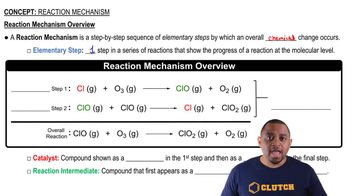
Reaction Mechanism

A reaction mechanism describes the step-by-step sequence of elementary reactions by which overall chemical change occurs. In this case, the mechanism involves two steps: the formation of a carbocation intermediate and its subsequent reaction with a chloride ion. Understanding the mechanism is crucial for analyzing how reactants transform into products and identifying the rate-limiting step.
Video consigliato:
Percorso guidato
03:06
Reaction Mechanism Overview

Rate Limiting Step

The rate limiting step in a reaction mechanism is the slowest step that determines the overall rate of the reaction. It is often characterized by a higher activation energy compared to other steps. In the provided mechanism, identifying which step is rate limiting involves examining the energy diagram to see where the largest energy barrier occurs, indicating the step that will take the longest to proceed.
Video consigliato:
Percorso guidato
4:53
Limiting Reagent Example

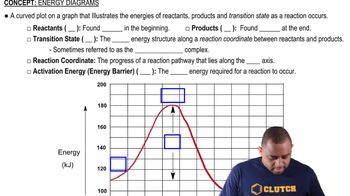
Energy Diagram

An energy diagram visually represents the energy changes during a chemical reaction, showing the energy of reactants, products, and intermediates. It typically includes activation energies for each step and the overall energy change. By analyzing the energy diagram associated with the reaction, one can determine the relative energies of the transition states and identify the rate limiting step based on the highest peak in the diagram.
Video consigliato:
Percorso guidato
01:57
Energy Diagrams