
Ch.14 - Chemical Kinetics
Tro - Chemistry: A Molecular Approach 4th Edition
Tro4th EditionChemistry: A Molecular ApproachISBN: 9780134112831Non è quello che usi tu?Cambia libro di testo
Capitolo 14, Problema 89

Dinitrogen pentoxide decomposes in the gas phase to form nitrogen dioxide and oxygen gas. The reaction is first order in dinitrogen pentoxide and has a half-life of 2.81 h at 25 °C. If a 1.5-L reaction vessel initially contains 745 torr of N2O5 at 25 °C, what partial pressure of O2 is present in the vessel after 215 minutes?

Guida verificata passo dopo passo
1
Identify the reaction: \( 2 \text{N}_2\text{O}_5 (g) \rightarrow 4 \text{NO}_2 (g) + \text{O}_2 (g) \).
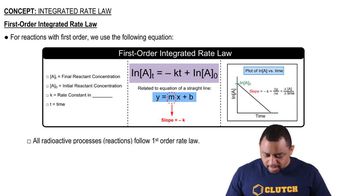
Since the reaction is first order, use the first-order kinetics equation: \( [A] = [A]_0 e^{-kt} \), where \( k \) is the rate constant.
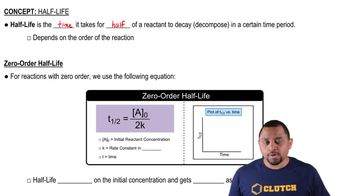
Calculate the rate constant \( k \) using the half-life formula for first-order reactions: \( t_{1/2} = \frac{0.693}{k} \).
Convert the time from minutes to hours to match the half-life units: \( 215 \text{ minutes} = 3.583 \text{ hours} \).
Use the integrated rate law to find the remaining \( \text{N}_2\text{O}_5 \) and then determine the amount of \( \text{O}_2 \) produced, considering the stoichiometry of the reaction.

Risposta video verificata per un problema simile:

Questa soluzione video è stata consigliata dai nostri tutor come utile per risolvere questo problema.

Concetti chiave

Ecco i concetti essenziali che devi comprendere per rispondere correttamente alla domanda.

First-Order Reactions

First-order reactions are chemical reactions where the rate is directly proportional to the concentration of one reactant. In this case, the decomposition of dinitrogen pentoxide (N2O5) follows first-order kinetics, meaning that as N2O5 is consumed, the rate of reaction decreases. The half-life of a first-order reaction is constant and can be used to determine the concentration of reactants over time.
Video consigliato:
Percorso guidato
02:29
First-Order Reactions

Half-Life

The half-life of a reaction is the time required for the concentration of a reactant to decrease to half of its initial value. For first-order reactions, the half-life is independent of the initial concentration. In this problem, the half-life of 2.81 hours allows us to calculate how much N2O5 remains after a specific time, which is crucial for determining the amount of products formed, including oxygen gas (O2).
Video consigliato:
Percorso guidato
02:17
Zero-Order Half-life

Partial Pressure

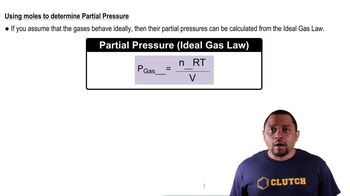
Partial pressure is the pressure exerted by a single component of a gas mixture. According to Dalton's Law of Partial Pressures, the total pressure of a gas mixture is the sum of the partial pressures of its individual gases. In this scenario, calculating the partial pressure of O2 produced from the decomposition of N2O5 involves understanding the stoichiometry of the reaction and the initial conditions of the system.
Video consigliato:
Percorso guidato
00:48
Partial Pressure Calculation