
Ch.14 - Chemical Kinetics
Tro - Chemistry: A Molecular Approach 4th Edition
Tro4th EditionChemistry: A Molecular ApproachISBN: 9780134112831Non è quello che usi tu?Cambia libro di testo
Capitolo 14, Problema 86

Consider the reaction: 2 O3(g) → 3 O2( g) The rate law for this reaction is: Rate = k [O3]2 [O2] Suppose that a 1.0-L reaction vessel initially contains 1.0 mol of O3 and 1.0 mol of O2. What fraction of the O3 will have reacted when the rate falls to one-half of its initial value?

Guida verificata passo dopo passo
1
Identify the initial rate of the reaction using the rate law: \( \text{Rate}_{\text{initial}} = k [\text{O}_3]^2 [\text{O}_2] \).
Determine the expression for the rate when it falls to half of its initial value: \( \text{Rate}_{\text{half}} = \frac{1}{2} \times \text{Rate}_{\text{initial}} \).
Set up the equation for the rate at half its initial value: \( \frac{1}{2} \times k [\text{O}_3]^2 [\text{O}_2] = k [\text{O}_3']^2 [\text{O}_2'] \), where \([\text{O}_3']\) and \([\text{O}_2']\) are the concentrations when the rate is halved.
Assume \( x \) moles of \( \text{O}_3 \) have reacted, then \([\text{O}_3'] = 1.0 - x\) and \([\text{O}_2'] = 1.0 + \frac{3}{2}x\) because for every 2 moles of \( \text{O}_3 \) that react, 3 moles of \( \text{O}_2 \) are produced.
Substitute \([\text{O}_3']\) and \([\text{O}_2']\) into the rate equation and solve for \( x \) to find the fraction of \( \text{O}_3 \) that has reacted.

Risposta video verificata per un problema simile:

Questa soluzione video è stata consigliata dai nostri tutor come utile per risolvere questo problema.
Durata del video:
7m

Concetti chiave

Ecco i concetti essenziali che devi comprendere per rispondere correttamente alla domanda.

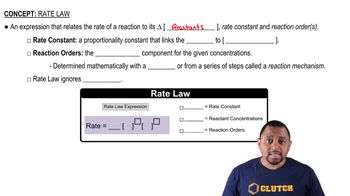
Rate Law

The rate law expresses the relationship between the rate of a chemical reaction and the concentration of its reactants. It is typically formulated as Rate = k [A]^m [B]^n, where k is the rate constant, and m and n are the orders of the reaction with respect to reactants A and B. Understanding the rate law is crucial for predicting how changes in concentration affect the reaction rate.
Video consigliato:
Percorso guidato
01:52
Rate Law Fundamentals

Reaction Order

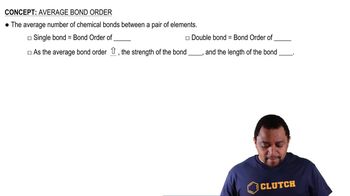
The reaction order is the sum of the exponents in the rate law and indicates how the rate of reaction depends on the concentration of reactants. In the given reaction, the order with respect to O<sub>3</sub> is 2, meaning that the rate is proportional to the square of its concentration. This concept helps in determining how the concentration of reactants influences the speed of the reaction.
Video consigliato:
Percorso guidato
00:36
Average Bond Order

Half-life of a Reaction

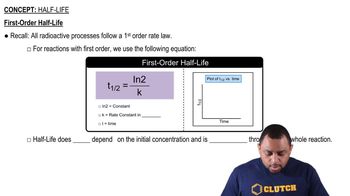
The half-life of a reaction is the time required for the concentration of a reactant to decrease to half of its initial value. For reactions of different orders, the half-life can vary significantly. In this context, understanding how the rate changes as the concentration of O<sub>3</sub> decreases is essential for calculating the fraction that has reacted when the rate falls to half its initial value.
Video consigliato:
Percorso guidato
01:49
First-Order Half-Life