Ch.14 - Chemical Kinetics
Tro - Chemistry: A Molecular Approach 4th Edition
Tro4th EditionChemistry: A Molecular ApproachISBN: 9780134112831Non è quello che usi tu?Cambia libro di testo
Capitolo 14, Problema 57a

The half-life for the radioactive decay of U-238 is 4.5 billion years and is independent of initial concentration. How long will it take for 10% of the U-238 atoms in a sample of U-238 to decay?

Guida verificata passo dopo passo
1
Understand the concept of half-life, which is the time required for half of the radioactive substance to decay. For U-238, this time is 4.5 billion years.
Set up the decay formula using the exponential decay model: \( N = N_0 \times e^{-kt} \), where \( N \) is the remaining amount of substance, \( N_0 \) is the initial amount, \( k \) is the decay constant, and \( t \) is time.
Calculate the decay constant \( k \) using the half-life formula: \( k = \frac{\ln(2)}{T_{1/2}} \), where \( T_{1/2} \) is the half-life of the substance.
Determine the time \( t \) when 90% of the original U-238 remains (since 10% has decayed). Use the decay formula, substituting \( N = 0.9N_0 \) and solve for \( t \).
Plug in the value of \( k \) from step 3 into the equation from step 4 and solve for \( t \) to find out how long it takes for 10% of the U-238 to decay.

Risposta video verificata per un problema simile:

Questa soluzione video è stata consigliata dai nostri tutor come utile per risolvere questo problema.

Concetti chiave

Ecco i concetti essenziali che devi comprendere per rispondere correttamente alla domanda.

Half-life

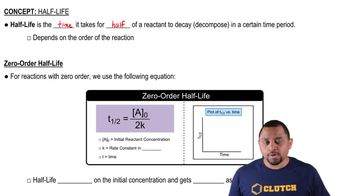
Half-life is the time required for half of the radioactive nuclei in a sample to decay. It is a constant property of each radioactive isotope, meaning it does not change regardless of the amount of substance present. For U-238, the half-life is 4.5 billion years, indicating that after this period, half of the original amount will have transformed into other elements.
Video consigliato:
Percorso guidato
02:17
Zero-Order Half-life

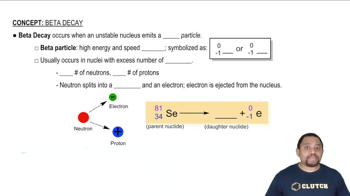
Exponential Decay

Radioactive decay follows an exponential decay model, where the quantity of a substance decreases at a rate proportional to its current value. This means that the decay process is continuous and can be described mathematically using the decay constant, which is related to the half-life. Understanding this concept is crucial for calculating the remaining quantity of a substance after a certain period.
Video consigliato:

Decay Calculation

To determine how long it takes for a specific percentage of a radioactive substance to decay, one can use the formula derived from the exponential decay model. For U-238, to find the time for 10% decay, one can set up the equation based on the initial amount and the remaining amount after decay, applying logarithmic functions to solve for time. This calculation illustrates the relationship between time, decay percentage, and half-life.
Video consigliato: