
Ch.14 - Chemical Kinetics
Tro - Chemistry: A Molecular Approach 4th Edition
Tro4th EditionChemistry: A Molecular ApproachISBN: 9780134112831Non è quello che usi tu?Cambia libro di testo
Capitolo 14, Problema 99a

The kinetics of this reaction were studied as a function of temperature. (The reaction is first order in each reactant and second order overall.)
C2H5Br(aq) + OH- (aq) → C2H5OH(l) + Br- (aq)
Temperature (°C) k (L,mol •s)
25 8.81⨉10-5
35 0.000285
45 0.000854
55 0.00239
65 0.00633
a. Determine the activation energy and frequency factor for the reaction.

Guida verificata passo dopo passo
1
Identify the Arrhenius equation: \(k = A e^{-\frac{E_a}{RT}}\), where \(k\) is the rate constant, \(A\) is the frequency factor, \(E_a\) is the activation energy, \(R\) is the gas constant (8.314 J/mol·K), and \(T\) is the temperature in Kelvin.
Convert the given temperatures from Celsius to Kelvin by adding 273.15 to each temperature value.
Take the natural logarithm of both sides of the Arrhenius equation to linearize it: \(\ln(k) = \ln(A) - \frac{E_a}{R} \cdot \frac{1}{T}\).
Plot \(\ln(k)\) versus \(\frac{1}{T}\) to obtain a straight line, where the slope of the line is \(-\frac{E_a}{R}\) and the y-intercept is \(\ln(A)\).
Calculate the slope of the line to find \(E_a\) using the relation \(E_a = -\text{slope} \times R\), and determine \(A\) by taking the exponential of the y-intercept: \(A = e^{\text{y-intercept}}\).

Risposta video verificata per un problema simile:

Questa soluzione video è stata consigliata dai nostri tutor come utile per risolvere questo problema.
Durata del video:
3m

Concetti chiave

Ecco i concetti essenziali che devi comprendere per rispondere correttamente alla domanda.

Reaction Kinetics

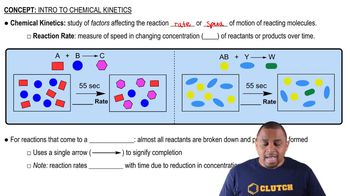
Reaction kinetics is the study of the rates of chemical reactions and the factors that affect these rates. It involves understanding how concentration, temperature, and catalysts influence the speed of a reaction. In this case, the reaction is first order in each reactant, indicating that the rate depends linearly on the concentration of each reactant.
Video consigliato:
Percorso guidato
03:06
Chemical Kinetics

Arrhenius Equation

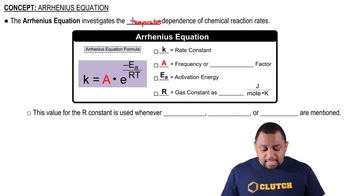
The Arrhenius equation relates the rate constant of a reaction to temperature and activation energy. It is expressed as k = A * e^(-Ea/RT), where k is the rate constant, A is the frequency factor, Ea is the activation energy, R is the gas constant, and T is the temperature in Kelvin. This equation is crucial for determining how temperature affects reaction rates and for calculating activation energy.
Video consigliato:
Percorso guidato
01:20
Arrhenius Equation

Activation Energy

Activation energy (Ea) is the minimum energy required for a chemical reaction to occur. It represents the energy barrier that reactants must overcome to form products. A higher activation energy means that fewer molecules have sufficient energy to react at a given temperature, which typically results in a slower reaction rate. Understanding Ea is essential for analyzing the temperature dependence of reaction rates.
Video consigliato:
Percorso guidato
02:02
Activity Series Chart
Pratica correlata
Domanda del libro di testo

The desorption (leaving of the surface) of a single molecular layer of n-butane from a single crystal of aluminum oxide is found to be first order with a rate constant of 0.128/s at 150 K. b. If the surface is initially completely covered with n-butane at 150 K, how long will it take for 25% of the molecules to desorb (leave the surface)? For 50% to desorb?

654
views
Domanda del libro di testo

The kinetics of this reaction were studied as a function of temperature. (The reaction is first order in each reactant and second order overall.)

C2H5Br(aq) + OH- (aq) → C2H5OH(l) + Br- (aq)

Temperature (°C) k (L,mol •s)

25 8.81⨉10-5

35 0.000285

45 0.000854

55 0.00239

65 0.00633

b. Determine the rate constant at 15 °C.

1072
views
Domanda del libro di testo

The kinetics of this reaction were studied as a function of temperature. (The reaction is first order in each reactant and second order overall.)

C2H5Br(aq) + OH- (aq) → C2H5OH(l) + Br- (aq)

Temperature (°C) k (L,mol •s)

25 8.81⨉10-5

35 0.000285

45 0.000854

55 0.00239

65 0.00633

c. If a reaction mixture is 0.155 M in C2H5Brand 0.250 M in OH-, what is the initial rate of the reaction at 75 °C?

Domanda del libro di testo

The evaporation of a 120-nm film of n-pentane from a single crystal of aluminum oxide is zero order with a rate constant of 1.92⨉1013 molecules/cm2•s at 120 K. a. If the initial surface coverage is 8.9⨉1016 molecules/cm2, how long will it take for one-half of the film to evaporate?

881
views
1
rank
Domanda del libro di testo

The reaction 2 N2O5 → 2 N2O4 + O2 takes place at around room temperature in solvents such as CCl4. The rate constant at 293 K is found to be 2.35⨉10-4 s-1, and at 303 K the rate constant is found to be 9.15⨉10-4 s-1. Calculate the frequency factor for the reaction.

1231
views