
Ch.14 - Chemical Kinetics
Tro - Chemistry: A Molecular Approach 4th Edition
Tro4th EditionChemistry: A Molecular ApproachISBN: 9780134112831Non è quello che usi tu?Cambia libro di testo
Capitolo 14, Problema 97b

The desorption (leaving of the surface) of a single molecular layer of n-butane from a single crystal of aluminum oxide is found to be first order with a rate constant of 0.128/s at 150 K. b. If the surface is initially completely covered with n-butane at 150 K, how long will it take for 25% of the molecules to desorb (leave the surface)? For 50% to desorb?

Guida verificata passo dopo passo
1
Identify that the desorption process is first-order, which means the rate of desorption depends on the concentration of n-butane on the surface.
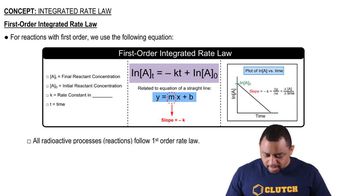
Use the first-order rate equation: \( \ln \left( \frac{[A]_0}{[A]} \right) = kt \), where \([A]_0\) is the initial concentration, \([A]\) is the concentration at time \(t\), \(k\) is the rate constant, and \(t\) is the time.
For 25% desorption, 75% of the n-butane remains on the surface. Set \([A] = 0.75[A]_0\) and solve for \(t\) using the equation: \( \ln \left( \frac{[A]_0}{0.75[A]_0} \right) = 0.128t \).
For 50% desorption, 50% of the n-butane remains on the surface. Set \([A] = 0.50[A]_0\) and solve for \(t\) using the equation: \( \ln \left( \frac{[A]_0}{0.50[A]_0} \right) = 0.128t \).
Calculate the time \(t\) for both scenarios using the natural logarithm and the given rate constant.

Risposta video verificata per un problema simile:

Questa soluzione video è stata consigliata dai nostri tutor come utile per risolvere questo problema.
Durata del video:
3m

Concetti chiave

Ecco i concetti essenziali che devi comprendere per rispondere correttamente alla domanda.

First-Order Kinetics

First-order kinetics refers to a reaction rate that is directly proportional to the concentration of one reactant. In this case, the desorption of n-butane follows first-order kinetics, meaning that the rate of desorption decreases as the concentration of n-butane on the surface decreases. The mathematical representation is given by the equation ln([A]0/[A]t) = kt, where [A]0 is the initial concentration, [A]t is the concentration at time t, k is the rate constant, and t is time.
Video consigliato:
Percorso guidato
02:29
First-Order Reactions

Rate Constant

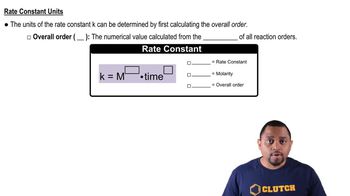
The rate constant (k) is a proportionality factor in the rate equation that provides insight into the speed of a reaction. For first-order reactions, the units of the rate constant are typically s⁻¹. In this scenario, the rate constant of 0.128/s indicates that the desorption process occurs relatively quickly at 150 K, allowing for calculations of how long it will take for specific percentages of n-butane to desorb from the surface.
Video consigliato:
Percorso guidato
00:45
Rate Constant Units

Exponential Decay

Exponential decay describes the process by which a quantity decreases at a rate proportional to its current value. In the context of desorption, the number of n-butane molecules remaining on the surface decreases exponentially over time. This relationship can be expressed mathematically, allowing us to determine the time required for a certain percentage of molecules to desorb, such as 25% or 50%, using the first-order kinetics equation.
Video consigliato: