Ch.14 - Chemical Kinetics
Tro - Chemistry: A Molecular Approach 4th Edition
Tro4th EditionChemistry: A Molecular ApproachISBN: 9780134112831Non è quello che usi tu?Cambia libro di testo
Capitolo 14, Problema 84a

The tabulated data were collected for this reaction at a certain temperature: X2Y → 2 X + Y a. Determine the order of the reaction and the value of the rate constant at this temperature.

Guida verificata passo dopo passo
1
Identify the general form of the rate law for the reaction, which can be expressed as Rate = k[X2Y]n, where k is the rate constant, [X2Y] is the concentration of the reactant, and n is the order of the reaction with respect to X2Y.
Plot the provided concentration data of X2Y against time on a graph to visually inspect how the concentration changes. This can help in determining the reaction order by looking at the shape of the curve.
To determine the order of the reaction (n), try fitting the data to different kinetic models: zero-order (plot [X2Y] vs. time), first-order (plot ln([X2Y]) vs. time), and second-order (plot 1/[X2Y] vs. time). The plot that results in a straight line indicates the order of the reaction.
Once the order of the reaction is determined from the best-fit line, use the slope of this line to calculate the rate constant (k). The relationship between the slope and k depends on the order of the reaction: for zero-order, slope = -k; for first-order, slope = -k; for second-order, slope = k.
Compile the results to summarize the order of the reaction and the value of the rate constant (k) at the given temperature.

Risposta video verificata per un problema simile:

Questa soluzione video è stata consigliata dai nostri tutor come utile per risolvere questo problema.
Durata del video:
2m

Concetti chiave

Ecco i concetti essenziali che devi comprendere per rispondere correttamente alla domanda.

Reaction Order

The order of a reaction refers to the power to which the concentration of a reactant is raised in the rate law. It indicates how the rate of reaction depends on the concentration of reactants. For example, a first-order reaction depends linearly on the concentration of one reactant, while a second-order reaction depends on the square of the concentration. Understanding the reaction order is crucial for determining how changes in concentration affect the reaction rate.
Video consigliato:
Percorso guidato
00:36
Average Bond Order

Rate Law

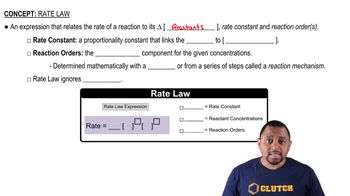
The rate law is an equation that relates the rate of a chemical reaction to the concentration of its reactants. It is typically expressed in the form Rate = k[A]^m[B]^n, where k is the rate constant, and m and n are the orders of the reaction with respect to reactants A and B, respectively. The rate law is determined experimentally and is essential for calculating the rate constant and understanding the kinetics of the reaction.
Video consigliato:
Percorso guidato
01:52
Rate Law Fundamentals

Rate Constant (k)

The rate constant, denoted as k, is a proportionality factor in the rate law that is specific to a particular reaction at a given temperature. It reflects the speed of the reaction; a larger k indicates a faster reaction. The value of k can be determined from experimental data and is influenced by factors such as temperature and the presence of catalysts. Understanding k is vital for predicting how quickly a reaction will proceed under specific conditions.
Video consigliato:
Percorso guidato
01:14
Equilibrium Constant K