Consider this reaction at equilibrium: 2 BrNO(g) ⇌ 2 NO(g) + Br2(g) Predict whether the reaction will shift left, shift right, or remain unchanged after each disturbance. b. BrNO is added to the reaction mixture.
Ch.15 - Chemical Equilibrium
Tro4th EditionChemistry: A Molecular ApproachISBN: 9780134112831Non è quello che usi tu?Cambia libro di testo
Capitolo 15, Problema 62
Consider the reaction: A(g) ⇌ 2B(g). Find the equilibrium partial pressures of A and B for each value of Kp. Assume that the initial partial pressure of B in each case is 1.0 atm and that the initial partial pressure of A is 0.0 atm. Make any appropriate simplifying assumptions. a. Kp = 1.0 b. Kp = 1.0 × 10^-4 c. Kp = 1.0 × 10^5.
Guida verificata passo dopo passo1
insert step 1
insert step 2
insert step 3
insert step 4
insert step 5
Concetti chiave
Ecco i concetti essenziali che devi comprendere per rispondere correttamente alla domanda.
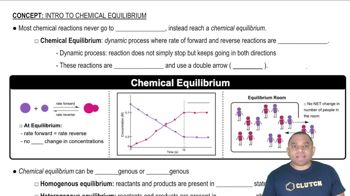
Chemical Equilibrium
Chemical equilibrium occurs when the rates of the forward and reverse reactions are equal, resulting in constant concentrations of reactants and products. In this case, the reaction A(g) ⇌ 2B(g) reaches a state where the partial pressures of A and B remain unchanged over time. Understanding this concept is crucial for analyzing how changes in conditions affect the equilibrium position and the concentrations of the species involved.
Video consigliato:
Percorso guidato
Chemical Equilibrium Concepts
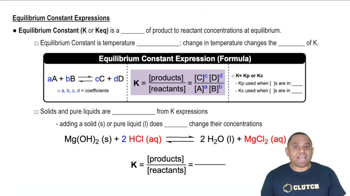
Equilibrium Constant (Kp)
The equilibrium constant, Kp, is a dimensionless value that expresses the ratio of the partial pressures of products to reactants at equilibrium, raised to the power of their stoichiometric coefficients. For the reaction A(g) ⇌ 2B(g), Kp is calculated as Kp = (P_B^2) / (P_A). Different values of Kp indicate the extent to which the reaction favors products or reactants, which is essential for determining the equilibrium partial pressures in this scenario.
Video consigliato:
Percorso guidato
Equilibrium Constant Expressions
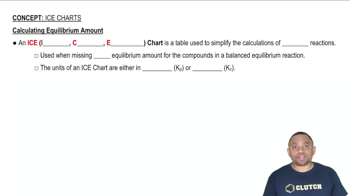
ICE Table (Initial, Change, Equilibrium)
An ICE table is a systematic way to organize the initial concentrations (or partial pressures), the changes that occur as the system reaches equilibrium, and the equilibrium concentrations. For the given reaction, the initial pressures of A and B, the changes in their pressures as the reaction proceeds, and the final equilibrium pressures can be calculated using this table. This method simplifies the process of solving for unknowns in equilibrium problems.
Video consigliato:
Percorso guidato
ICE Charts and Equilibrium Amount
Pratica correlata
Domanda del libro di testo
773
views
Domanda del libro di testo
Consider this reaction at equilibrium: 2 BrNO(g) ⇌ 2 NO(g) + Br2(g) Predict whether the reaction will shift left, shift right, or remain unchanged after each disturbance. a. NO is added to the reaction mixture.
815
views
Domanda del libro di testo
Consider the reaction: A(g) ⇌ B(g) + C(g) Find the equilibrium concentrations of A, B, and C for each value of Kc. Assume that the initial concentration of A in each case is 1.0 M and that the reaction mixture initially contains no products. Make any appropriate simplifying assumptions. b. Kc = 0.010
4059
views
1
rank
Domanda del libro di testo
Consider the reaction: SO2Cl2(g) ⇌ SO2(g) + Cl2(g) Kc = 2.99⨉10-7 at 227 °C If a reaction mixture initially contains 0.175 M SO2Cl2, what is the equilibrium concentration of Cl2 at 227 °C?
2819
views