
For the reaction shown here, Kc = 255 at 1000 K. CO(g) + Cl2(g) ⇌ COCl2(g) If a reaction mixture initially contains a CO concentration of 0.1500 M and a Cl2 concentration of 0.175 M at 1000 K, what are the equilibrium concentrations of CO, Cl2, and COCl2 at 1000 K?
Ch.15 - Chemical Equilibrium
Tro4th EditionChemistry: A Molecular ApproachISBN: 9780134112831Non è quello che usi tu?Cambia libro di testo
Capitolo 15, Problema 56
Consider the reaction: CO(g) + H2O(g) ⇌ CO2(g) + H2(g) Kc = 102 at 500 K. If a reaction mixture initially contains 0.110 M CO and 0.110 M H2O, what will the equilibrium concentration of each of the reactants and products be?
Guida verificata passo dopo passo1
Identify the initial concentrations of the reactants: [CO] = 0.110 M and [H2O] = 0.110 M. The initial concentrations of the products [CO2] and [H2] are 0 M.
Set up an ICE (Initial, Change, Equilibrium) table to track the changes in concentrations as the system reaches equilibrium. Let x be the change in concentration for CO and H2O as they react.
Write the expression for the equilibrium constant Kc: Kc = ([CO2][H2])/([CO][H2O]).
Substitute the equilibrium concentrations from the ICE table into the Kc expression: Kc = ((x)(x))/((0.110-x)(0.110-x)).
Solve the equation for x using the given Kc value (102) to find the equilibrium concentrations of all species.
Concetti chiave
Ecco i concetti essenziali che devi comprendere per rispondere correttamente alla domanda.
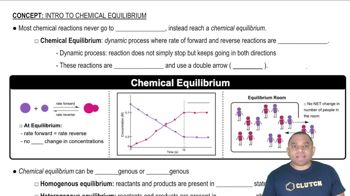
Chemical Equilibrium
Chemical equilibrium occurs when the rates of the forward and reverse reactions are equal, resulting in constant concentrations of reactants and products. In this state, the system is dynamic, meaning that reactions continue to occur, but there is no net change in concentration. Understanding this concept is crucial for analyzing how concentrations shift in response to changes in conditions.
Video consigliato:
Percorso guidato
Chemical Equilibrium Concepts
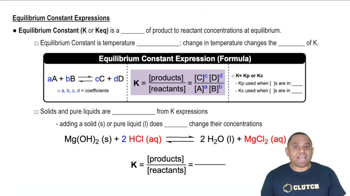
Equilibrium Constant (Kc)
The equilibrium constant (Kc) is a numerical value that expresses the ratio of the concentrations of products to reactants at equilibrium, each raised to the power of their coefficients in the balanced equation. For the given reaction, Kc = [CO2][H2]/[CO][H2O]. This constant provides insight into the position of equilibrium and helps predict the concentrations of species at equilibrium based on initial concentrations.
Video consigliato:
Percorso guidato
Equilibrium Constant Expressions
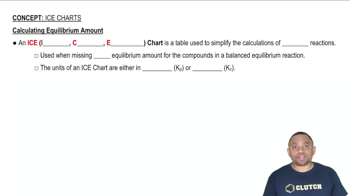
ICE Table (Initial, Change, Equilibrium)
An ICE table is a tool used to organize the initial concentrations, the changes in concentrations as the reaction proceeds, and the equilibrium concentrations of reactants and products. By setting up an ICE table, one can systematically determine how the initial concentrations of CO and H2O will change to reach equilibrium, allowing for the calculation of equilibrium concentrations using the Kc value.
Video consigliato:
Percorso guidato
ICE Charts and Equilibrium Amount
Pratica correlata
Domanda del libro di testo
3268
views
1
rank
Domanda del libro di testo
For the reaction shown here, Kc = 0.513 at 500 K. N2O4(g) ⇌ 2 NO2(g) If a reaction vessel initially contains an N2O4 concentration of 0.0500 M at 500 K, what are the equilibrium concentrations of N2O4 and NO2 at 500 K?
2036
views
1
comments
Domanda del libro di testo
Consider the reaction: SO2Cl2(g) ⇌ SO2(g) + Cl2(g) Kc = 2.99⨉10-7 at 227 °C If a reaction mixture initially contains 0.175 M SO2Cl2, what is the equilibrium concentration of Cl2 at 227 °C?
2819
views
Domanda del libro di testo
Consider the reaction: HC2H3O2(aq) + H2O(l) ⇌ H3O+(aq) + C2H3O2-(aq) Kc = 1.8⨉10-5 at 25°C If a solution initially contains 0.210 M HC2H3O2, what is the equilibrium concentration of H3O+ at 25 °C?
3717
views
