
Ch.15 - Chemical Equilibrium
Tro - Chemistry: A Molecular Approach 4th Edition
Tro4th EditionChemistry: A Molecular ApproachISBN: 9780134112831Non è quello che usi tu?Cambia libro di testo
Capitolo 15, Problema 29

Consider the reactions and their respective equilibrium
constants:
NO(g) + 1/2 Br (g) ⇌ NOBr(g) Kp = 5.3
2 NO(g) ⇌ N2(g) + O2(g) Kp = 2.1⨉1030
Use these reactions and their equilibrium constants to predict
the equilibrium constant for the following reaction: N2(g) + O2(g) + Br2(g) ⇌ 2 NOBr(g)

Guida verificata passo dopo passo
1
Identify the target reaction: \( \text{N}_2(g) + \text{O}_2(g) + \text{Br}_2(g) \rightleftharpoons 2\text{NOBr}(g) \).
Recognize that the target reaction can be obtained by manipulating the given reactions.
Reverse the second reaction: \( \text{N}_2(g) + \text{O}_2(g) \rightleftharpoons 2\text{NO}(g) \), which changes its equilibrium constant to \( K' = \frac{1}{K_p} = \frac{1}{2.1 \times 10^{30}} \).
Multiply the first reaction by 2: \( 2\text{NO}(g) + \text{Br}_2(g) \rightleftharpoons 2\text{NOBr}(g) \), which squares its equilibrium constant to \( K'' = (5.3)^2 \).
Combine the modified reactions to match the target reaction and multiply their equilibrium constants: \( K_{\text{target}} = K' \times K'' \).

Risposta video verificata per un problema simile:

Questa soluzione video è stata consigliata dai nostri tutor come utile per risolvere questo problema.
Durata del video:
7m

Concetti chiave

Ecco i concetti essenziali che devi comprendere per rispondere correttamente alla domanda.

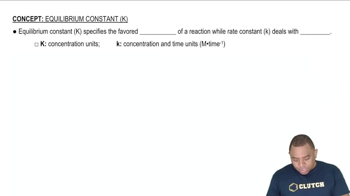
Equilibrium Constant (K)

The equilibrium constant (K) is a numerical value that expresses the ratio of the concentrations of products to reactants at equilibrium for a given chemical reaction. It provides insight into the extent to which a reaction proceeds; a large K indicates a reaction that favors products, while a small K suggests a preference for reactants. Understanding K is essential for predicting the behavior of chemical systems at equilibrium.
Video consigliato:
Percorso guidato
01:14
Equilibrium Constant K

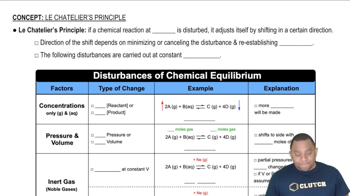
Le Chatelier's Principle

Le Chatelier's Principle states that if a dynamic equilibrium is disturbed by changing the conditions, the system will adjust to counteract the change and restore a new equilibrium. This principle helps predict how changes in concentration, pressure, or temperature will affect the position of equilibrium, which is crucial when manipulating reactions to achieve desired outcomes.
Video consigliato:
Percorso guidato
07:32
Le Chatelier's Principle

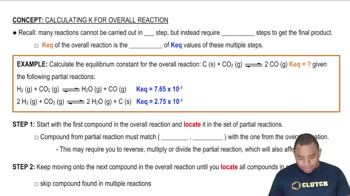
Manipulating Equilibrium Reactions

To find the equilibrium constant for a new reaction based on known reactions, one can manipulate the given reactions by reversing them or multiplying them to derive the desired equation. The equilibrium constants for these manipulated reactions can then be combined using multiplication or inversion rules. This concept is vital for predicting the equilibrium constant of complex reactions from simpler, known reactions.
Video consigliato:
Percorso guidato
07:02
Overall Reaction Equilibrium Constant