
Ch.15 - Chemical Equilibrium
Tro - Chemistry: A Molecular Approach 4th Edition
Tro4th EditionChemistry: A Molecular ApproachISBN: 9780134112831Non è quello che usi tu?Cambia libro di testo
Capitolo 15, Problema 28b

This reaction has an equilibrium constant of Kp = 2.2⨉106 at 298 K. 2 COF2(g) ⇌ CO2(g) + CF4(g) Calculate Kp for each reaction and predict whether reactants or products will be favored at equilibrium.
b. 6 COF2(g) ⇌ 3 CO2(g) + 3 CF4(g)

Guida verificata passo dopo passo
1
Identify the relationship between the original reaction and the new reaction. The new reaction is essentially three times the original reaction.
Use the rule for equilibrium constants when a reaction is multiplied by a factor. If a balanced equation is multiplied by a factor 'n', the new equilibrium constant K' is the original K raised to the power of 'n'.
Apply the rule to the given Kp value. Since the new reaction is three times the original, raise the original Kp to the power of 3.
Calculate Kp for the new reaction using the formula Kp,new = (Kp,original)^3.
Predict whether reactants or products are favored by comparing the magnitude of the new Kp. If Kp is much greater than 1, products are favored; if Kp is much less than 1, reactants are favored.

Risposta video verificata per un problema simile:

Questa soluzione video è stata consigliata dai nostri tutor come utile per risolvere questo problema.
Durata del video:
1m

Concetti chiave

Ecco i concetti essenziali che devi comprendere per rispondere correttamente alla domanda.

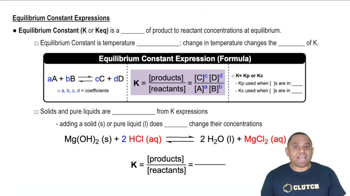
Equilibrium Constant (Kp)

The equilibrium constant (Kp) is a numerical value that expresses the ratio of the concentrations of products to reactants at equilibrium for a given reaction at a specific temperature. It is calculated using the partial pressures of gases involved in the reaction. A large Kp value (greater than 1) indicates that products are favored at equilibrium, while a small Kp value (less than 1) suggests that reactants are favored.
Video consigliato:
Percorso guidato
03:20
Equilibrium Constant Expressions

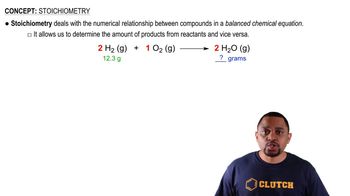
Reaction Stoichiometry

Reaction stoichiometry refers to the quantitative relationship between the amounts of reactants and products in a chemical reaction, as described by the balanced chemical equation. It is essential for calculating the equilibrium constant for different stoichiometric coefficients. In the given reaction, the stoichiometry must be adjusted to determine how the equilibrium constant changes when the coefficients of the reactants and products are altered.
Video consigliato:
Percorso guidato
01:16
Stoichiometry Concept

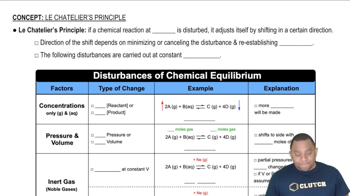
Le Chatelier's Principle

Le Chatelier's Principle states that if a dynamic equilibrium is disturbed by changing the conditions, the system will adjust itself to counteract the change and restore a new equilibrium. This principle helps predict the direction in which a reaction will shift when changes in concentration, pressure, or temperature occur. Understanding this principle is crucial for determining whether reactants or products will be favored at equilibrium based on the given equilibrium constant.
Video consigliato:
Percorso guidato
07:32
Le Chatelier's Principle
Pratica correlata
Domanda del libro di testo

Consider the reactions and their respective equilibrium

constants:

NO(g) + 1/2 Br (g) ⇌ NOBr(g) Kp = 5.3

2 NO(g) ⇌ N2(g) + O2(g) Kp = 2.1⨉1030

Use these reactions and their equilibrium constants to predict

the equilibrium constant for the following reaction: N2(g) + O2(g) + Br2(g) ⇌ 2 NOBr(g)

115
views
1
rank
Domanda del libro di testo

This reaction has an equilibrium constant of Kp = 2.2⨉106 at 298 K. 2 COF2(g) ⇌ CO2(g) + CF4(g) Calculate Kp for each reaction and predict whether reactants or products will be favored at equilibrium.

c. 2 CO2(g) + 2 CF4(g) ⇌ 4 COF2(g)

631
views
Domanda del libro di testo

Calculate Kc for each reaction. a. I2(g) ⇌ 2I(g) Kp = 6.26⨉10-22 (at 298K)

1992
views
Domanda del libro di testo

This reaction has an equilibrium constant of Kp = 2.2⨉106 at 298 K. 2 COF2(g) ⇌ CO2(g) + CF4(g) Calculate Kp for each reaction and predict whether reactants or products will be favored at equilibrium.

a. COF2 (g) ⇌ 1/2 CO2(g) + 1/2 CF4(g)

2676
views
1
comments
Domanda del libro di testo

This reaction has an equilibrium constant of Kp = 2.26⨉104 at 298 K. CO(g) + 2 H2(g) ⇌ CH3OH(g) Calculate Kp for each reaction and predict whether reactants or products will be favored at equilibrium.

c. 2 CH3OH(g) ⇌ 2 CO(g) + 4 H2(g)

726
views
Domanda del libro di testo

This reaction has an equilibrium constant of Kp = 2.26⨉104 at 298 K. CO(g) + 2 H2(g) ⇌ CH3OH(g) Calculate Kp for each reaction and predict whether reactants or products will be favored at equilibrium.

b. 1/2 CO(g) + H2 (g) ⇌ 1/2 CH3OH(g)

3230
views